See what Los Angeles PBS has to say about our film!
The Piping Plovers of Moonlight Bay airs Tuesday, April 15 at 8 PM
“Against the ever-changing tides of the Atlantic, a tiny but mighty family fights for survival. The Piping Plovers of Moonlight Bay follows a devoted pair of these rare shorebirds as they raise their marshmallow-sized chicks on a bustling urban beach. Every day is a test of their resilience—avoiding predators, braving unpredictable weather, and navigating a world where humans and wildlife collide. Will their fragile brood make it to adulthood?
This heartwarming and visually stunning special takes you inside the incredible journey of one of nature’s most determined parents. Witness breathtaking moments of survival and the deep bonds that keep these feathered families together. A story of hope, adaptation, and the delicate balance of our ecosystems.
Tune in for an unforgettable look at one of nature’s most compelling underdog stories. Sometimes, the smallest creatures have the most powerful stories to tell.”
California Friends, please check listings as The Piping Plovers of Moonlight Bay is airing at your local stations – KCET, KOCE, KVCR, KPJK, KQED, KQEH, KRCB, and KVPT.
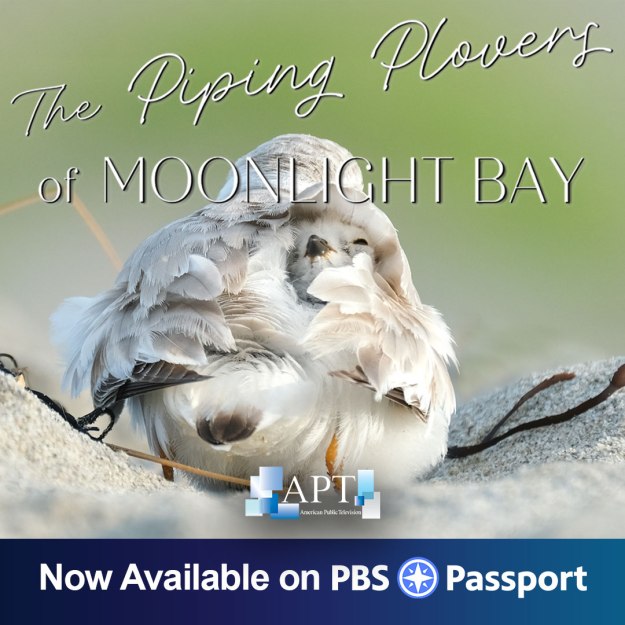
Checkout this lovely graphic created for us at American Public Television for our release on PBS! Beginning today, April 1st, The Piping Plovers of Moonlight Bay is airing on public television. Please check your local listings for times.
As a Passports member, you can also stream the film at anytime. We find our family’s membership to PBS invaluable; the programming is stellar and costs a fraction of any other streaming service, just $5.00 per month. We are members of New Hampshire PBS, which is also one of the 290 stations nationwide airing The Piping Plovers of Moonlight Bay. Here is the link on how to join: https://nhpbs.org/watchmore/
We have wonderful news to share. Our Good Harbor Beach Piping Plovers are returning! Not only that, but the original pair that have been nesting at GHB since 2016 were the first to arrive. Both Mom and Dad appeared on the very same day, March 19th, the earliest date ever. At this time of year, my husband and I check the beach daily so that we can track from year to year when Plovers begin arriving. Last year I believe it was March 25th.
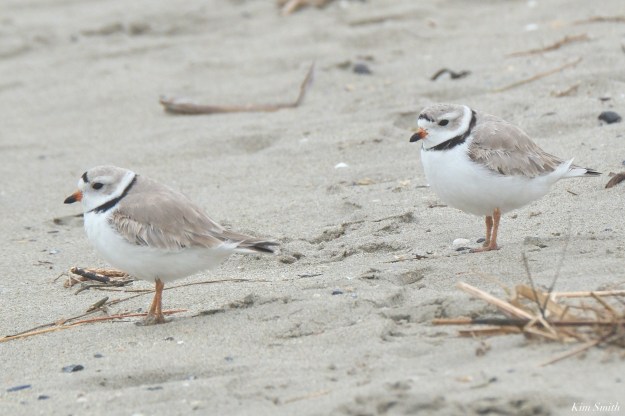
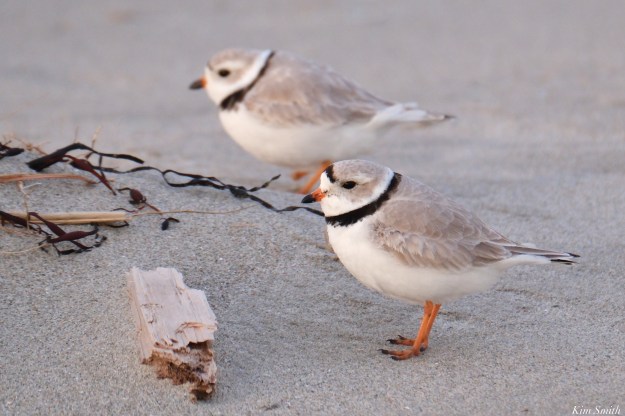
Super Dad and Handicapped Mom, March 19, 2025
A Plover love story for the ages is how my friend Todd describes it when Plover pairs nest together for many years. These two sweet Plovers must be at a minimum of 11 years old because Plovers don’t begin breeding until they are at least one year old. Eleven years is quite a ripe old age for Plovers as most live on average only five years. We wait with a combination of fear and excitement each spring, hoping and praying our Plover family makes it through another winter, especially now that Mom’s right foot is missing. She lost her foot several years ago after nylon fishing line and seaweed became tightly wound around her lower leg.
When you think about it, we have been through so much with this little Mom and Dad. The first several years especially were extremely challenging. Beachgoers did not yet understand how to help protect the birds and pets had the run of the beach. In fact, conditions were so bad on the beach that in 2018 Mom and Dad decided ‘enough with dog disturbances,’ and the safest place to nest was the GHB parking lot. Because of this, Massachusetts State and US Federal wildlife officials became heavily involved with helping to protect Gloucester Plovers and the local government began to take Plover protections more seriously. Little by little, things began to change for the better.
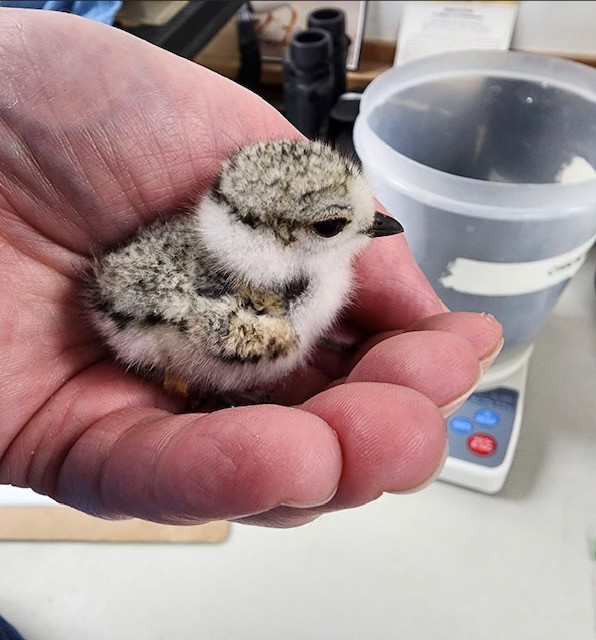
I remember our tender little handicapped Plover, nicknamed HipHop for his gimpy walk. It was Mom’s first season breeding without her right foot and she was extremely clumsy when transitioning to get in and out of the nest and when she was snuggling the chicks. I think she must have injured HipHop somehow because his injury manifested itself when he was about ten days old. Mother and chick were quite the pair with their hip hopping gaits. We thought HipHop would never grow to the size of his siblings and wondered if he would ever be able to fly. Mom departed early as is not unusual for females to begin migrating before their mates. Our Super Dad stayed with HipHop for many weeks after and throughout the entire summer. Both departed around the beginning of September, but not until HipHop was flying just as well as his siblings.
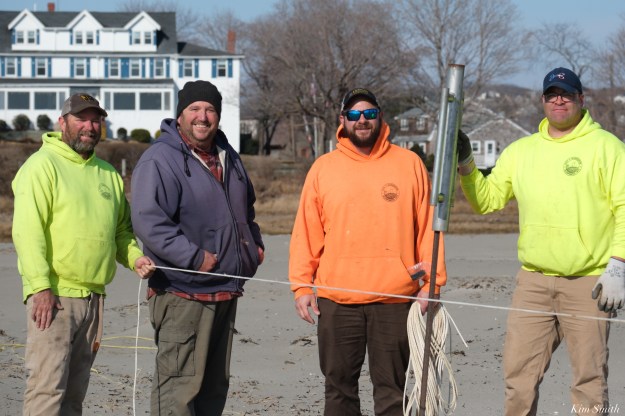
Dean Horne, Brian Watson, John Trupiano, and Adam Kelley installing Piping Plover protections
Thank you to the Gloucester DPW crew for installing the symbolic ropes and Plover signs. We appreciate everything the DPW does to keep Plovers safe and our local beaches looking beautiful!
If you happen to see Plovers on the beach, please give them lots and lots of space. Know that they are weary from the long migration and need to rest and refuel before ‘setting up house.’
Piping Plovers are returning to beaches all along the Atlantic Coast. The addendum to this note is for several new Plover friends from beaches in Maine and New Jersey who have written to ask how they can better help their community’s Plover families successfully fledge chicks.
Happy Spring from Ploverville!
Warmest wishes,
Kim
Actions that communities and beachgoers can take early in the season to help Plovers successfully breed include the following. I can not stress ‘early in the season’ enough. The earlier the Plovers nest without disturbances, the earlier they will begin laying eggs, and the earlier the chicks will fledge and begin migrating.
1) Disallow all pets on the beach, ideally beginning March 15th, April 1st at the latest.
2) Install symbolic roping around known Plover nesting areas by March 15th.
3) Install informational signage on beaches where Plovers nest by March 15th.
4) Do not permit off-road vehicles on beaches where shorebirds are nesting.
5) Do not rake the beach. Beach raking destroys a vital food source and machines can scoop up and kill chicks that can’t yet fly out of the way of danger.
6) Respect symbolically roped off areas. Do not play ball close to the roping. It is against state and federal law to run into the nesting area to retrieve a ball or for any other reason. Do not allow pets to run through the roped off areas and do not cross the roped off areas to take shortcuts through the dunes.
Thank you to all who attended our documentary screening of The Piping Plovers of Moonlight Bay on Sunday afternoon. We had a terrific group of attendees, both very generous and wonderfully engaged in the Qand A following the screening. I loved discussing Plovers and filmmaking with our guests and appreciate so much everyone who took the time out of their busy schedules to come and support the film.
Many, many thanks to Sarah, MAGMA’s founder and director, for hosting the event. In addition to offering a range of youth and adult dance classes, MAGMA provides an exceptional space for the community. Sarah hosts a range of events including films, dance performances, and local musicians, from punk bands, to string quartets! See MAGMA’s upcoming events here.
A very special shout out to Piping Plover Ambassadors Jonathan and Sally for their continued support and kind generosity. They provided all the beverages, Jonathan made an excellent bartender, and they both made everyone feel very welcome.
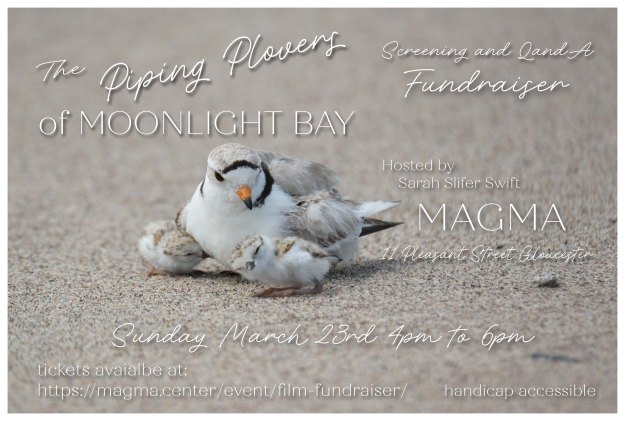
I hope to see you Sunday at our film screening fundraiser. Refreshments will be provided and following the screening, we’ll have lots of good discussion and wonderful news to share.
Although the postcard says handicapped accessible, unfortunately the elevator is now temporarily not working. Please let me know if you have purchased tickets and can no longer attend due to inaccessibility.
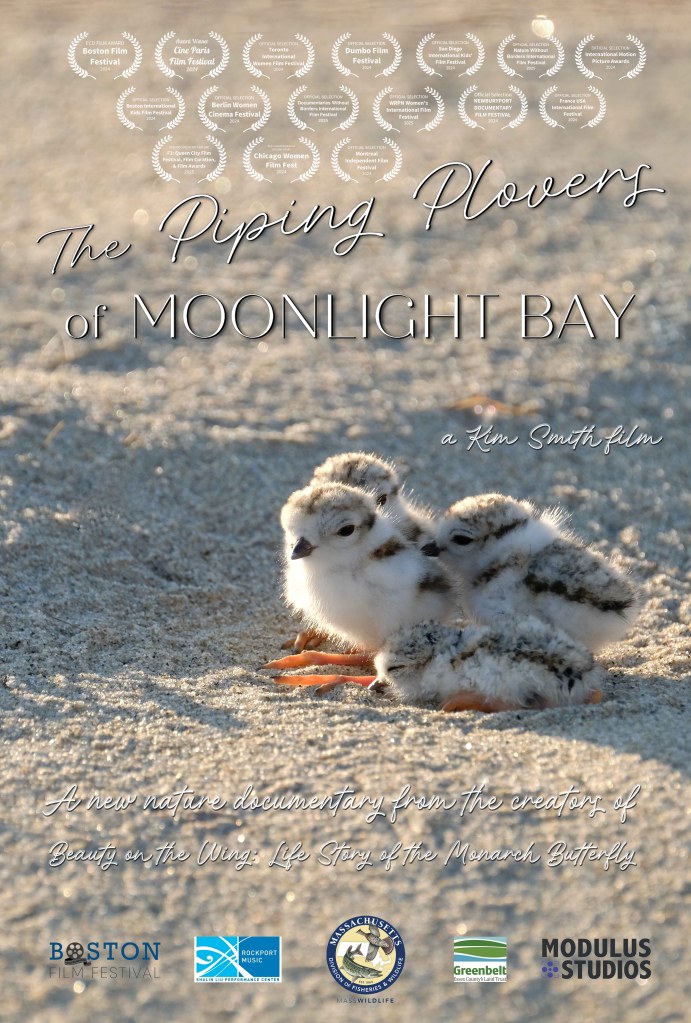
The Piping Plovers of Moonlight Bay is a 57-minute narrated documentary by Kim Smith that tells the story of the Piping Plover as it unfolds along the North Atlantic coastline. The film features a pair of courageous Plovers that overcome life-threatening obstacles while nesting at one of the region’s most popular beaches.
On Sunday March 23 at 4pm, MAGMA will host a fundraiser to help support the production and distribution of the film. This evening will include a showing of the film and a Q & A with filmmaker Kim Smith. Refreshments will be served. Suggested donation for this event is $50 (or what you can afford). For tickets please go here.
Each spring, northward migrating Atlantic coast Piping Plovers return to breeding sites located from North Carolina to Newfoundland. Amazingly, nesting often takes place on public beaches, where anyone can observe their beautiful life story unfolding. But in such areas, where people enjoy a full range of recreational activities, nesting and raising chicks is a perilous occupation.
Set against the backdrop of the ever-dynamic Atlantic shoreline, the documentary illustrates how conservation partners have provided safe corridors that allow these highly vulnerable birds to raise chicks to fledge at even the most well-loved beaches.
The Piping Plovers of Moonlight Bay is a film for all ages, and was created to inspire a love for wild creatures and their habitats, and to develop a deeper understanding of the vital role that wildlife play in our interconnected ecosystem.
Every stage of the Plover’s life cycle is experienced in vibrant HD and 4K close-up, from egg to chick to adult.
Production and distribution of The Piping Plovers of Moonlight Bay will be made possible by tax-deductible contributions from individuals, corporations, foundations, and public agencies.
To date, among other generous donations, we have received a leadership grant of $15,000 from the Massachusetts Division of Fisheries and Wildlife.
Gifts for The Piping Plovers of Moonlight Bay will support post production and distribution costs, color and sound editors, picture mastering, studio time, festival fees and applications, music and map rights, and an underwriting agent to bring the film to the wide audience of public television. Our goal is to raise $115,000.
I hope all is going well with your holiday making. I am grateful for the return of warm weather even if it is only going to last a few days, not only for the sunshine but also because our visiting Wood Duck has also been spotted basking in the warmth.
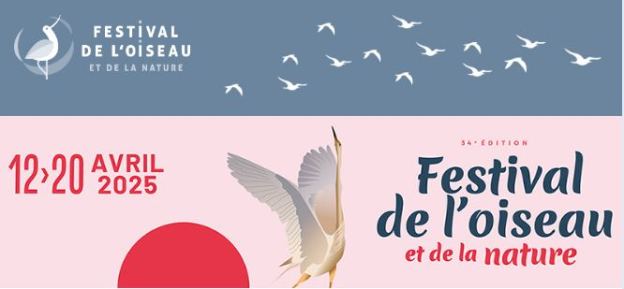
I have excellent news to share. The Piping Plovers of Moonlight Bay has been accepted to the Festival de l’Oiseau et de la Nature! It is the largest nature festival in France and takes place over a nine day period at the Bay of Somme. Located in the North of France, the Bay of Somme is an internationally recognized migratory site. For the past 33 years, in celebration of spring migration, the Festival has offered documentary screenings, activities for children, lectures, courses, and photo and art exhibits. This is a festival we were really, really hoping to be accepted to and I am over the Moon. We also recently received Best in Festival at the Nature Without Borders Film Festival and Outstanding Excellence at their sister festival, Documentaries Without Borders. It’s been a very exciting last couple of weeks.
Many readers who receive this newsletter have already contributed to the first phase of fundraising, to bring our documentary to festivals, and we are beyond grateful. We are now in the second round of fundraising, to bring the film to public television. A bunch of PiPl friends have mentioned they would like to contribute to this second round by year’s end. We are so appreciative of all the generous donations given to date and this is just a gentle reminder. If you are planning to contribute, or if I can answer any questions, please let me know. Again, all contributions, both through our online fundraiser and larger contributions, are tax deductible as we work with our 501c3 fiscal sponsor, Filmmakers Collaborative.
On a much less positive note, here is a link to a recent story that I wrote about the parasitic disease mange, the connection between the disease and rodenticides, and how rat poison is impacting both mammals and raptors. I shared photos of a local Coyote suffering from an advanced stage of mange, so don’t click on this link if you are feeling at all low.
Perhaps the most positive news of the month is that the Monarch may soon be listed as Threatened under the Endangered Species Act. Many organizations and individuals have worked tirelessly to bring this proposed listing about. USFWS is seeking public input on the Monarch’s ESA listing over a 90 day period, from December 12th through March 12th. If you would like to comment, please follow this link.
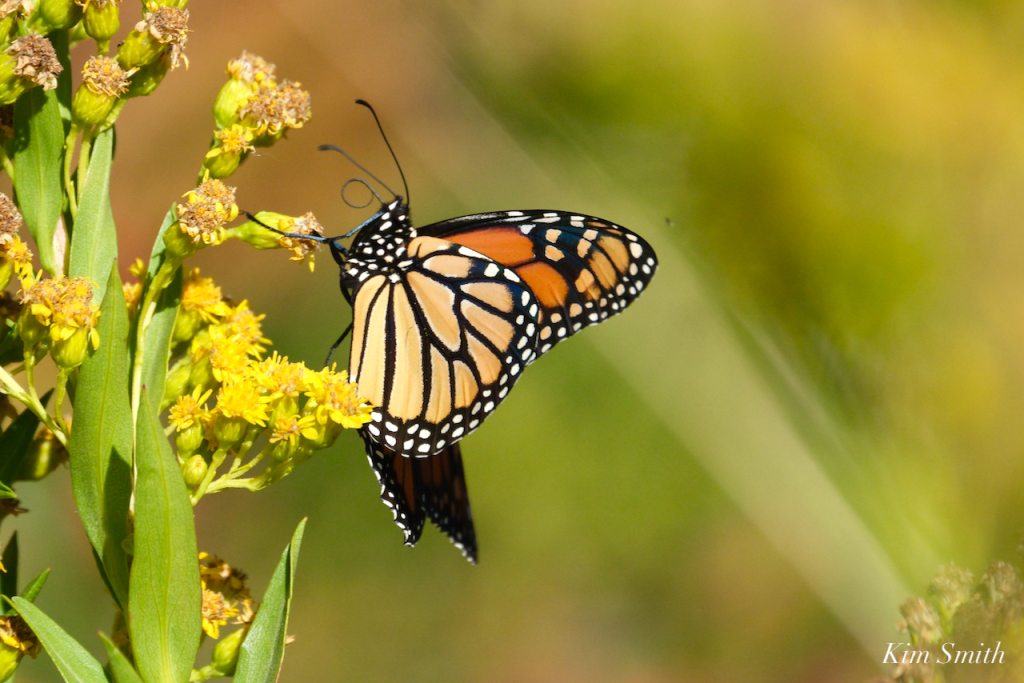
The photo below is of a Monarch and Seaside Goldenrod and was taken at the beautiful Manomet Center for Conservation Sciences this past October.
Happy Holidays and holiday-making! Warmest wishes, xxKim
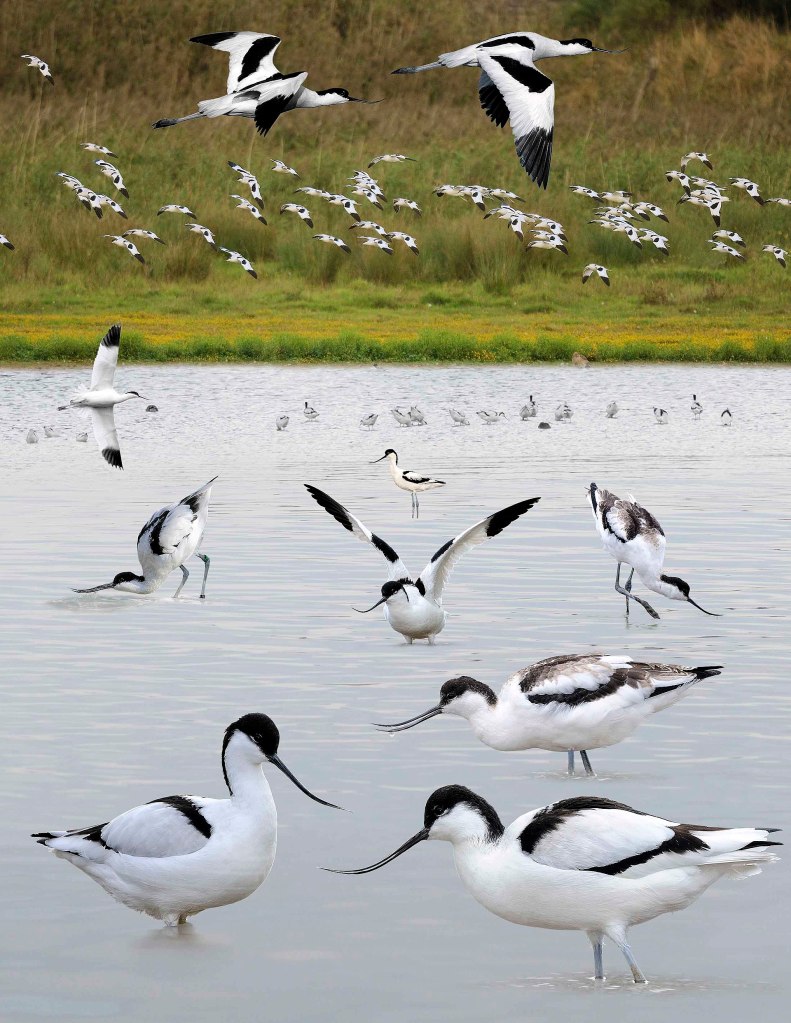
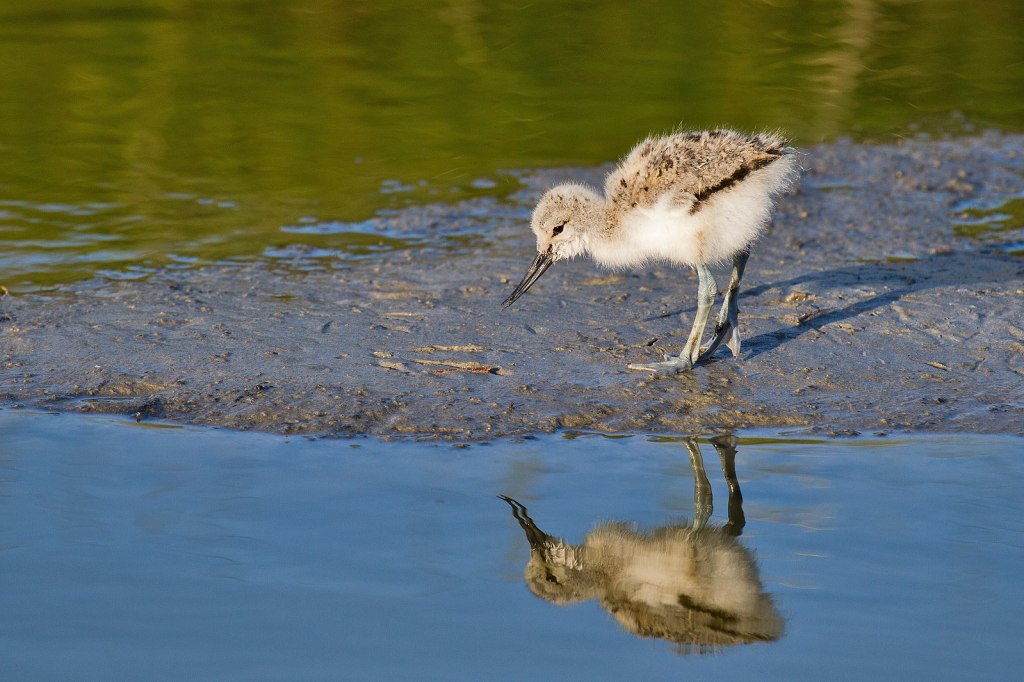
Isn’t this bird just beyond exquisite?! The Pied Avocet. It returns each spring to the Bay of Somme to breed. I read that after mating, a pair will cross their bills as part of the bonding ritual, and you can see how absolutely adorable are the chicks. Composite image and chick photo courtesy wikicommons media.
We are very surprised and delighted to share that The Piping Plovers of Moonlight Bay received the top award at the Nature Without Borders International Film Festival! The screening event takes place in Delaware sometime in June and and we’ll let you know more as do we know more. This past week we also received the Outstanding Excellence Award for a Wildlife/Nature Documentary at the Women’s International Film Festival – a two award week! I don’t think that will ever happen again. Thank you once again to all our supporters. We would not be this far along in production without your kind and generous help.
In thinking about Thanksgiving, I just wanted to say thank you to all of you for your generous contributions and tremendous help in our efforts to bring our documentary to public television. We still have aways to go, but are making good headway in the fundraising department. Your gifts have been tremendously impactful and we could not have gotten this close without your help.
After my last post about the continued harassment and heartbreaking death of one of the recently arrived Snowy Owls, I wanted to share with you a much more joyful story for Thanksgiving, a story about a very inspiring person and her gift to our Plover documentary.
Through a mutual friend, Scott Hecker, I have met the actress and wildlife conservationist Jane Alexander. Many of our PiPl friends in Massachusetts will recognize Scott’s name. He has been a resolute force in Atlantic shorebird conservation for decades. Scott led Mass Audubon’s Piping Plover recovery efforts, resulting in the threatened species’ state population increasing from 126 pairs in 1987 to 530 pairs by 2002. He subsequently served as Director of National Audubon’s Coastal Bird Conservation program and currently works with the International Conservation Fund of Canada to manage and develop the organization’s shorebird conservation efforts.
Jane Alexander is the multi-talented Emmy and Tony award winning stage and film actress, producer, and director who you may recall, starred with James Earl Jones in the groundbreaking film, The Great White Hope, political thrillers such as All the President’s Men, and many, many other plays and films that have captured the zeitgeist of our times. She also served as chairwoman for the National Endowment for the Arts under President Clinton.
In addition to her wide-ranging theatrical accomplishments, Jane is also a dedicated conservationist and champion of creatures great and small, and their habitats. She uses her powerful voice to write beautifully thoughtful stories about wildlife. I have loved reading her most recent book, Wild Things Wild Places, Adventurous Tales of Wildlife and Conservation on Planet Earth and think you will love it, too. One of the main themes of the book is documenting the work that field biologists are doing within communities to save the species where the species they are studying lives. She writes about biologists who are helping people understand what they have in their own backyards and to feel pride in their beautiful place, recognizing there is no conservation without inclusion.
Jane is also a Piping Plover guardian at her home in Nova Scotia! She has been monitoring Piping Plovers in Shelburne County for close to 25 years. Jane spoke about her responsibilities in an Audubon article “Bird Talk with Jane Alexander,” “I go out two times a week to check on the nests that we know of on the beaches in the southwest area here in Nova Scotia. If there are people with dogs off the leash, I speak to them. I make sure the signs are still up, and if it’s a beautiful, sunny day and there are many people on the beach, I talk to them about the birds. Lots of people are doing this all over the Maritimes during the nesting season, which began about a month ago and will go rarely past the second week of July.”
In addition to the many conservation organizations she works with, Jane has been deeply involved with the Indianapolis Zoological Society for a number of years. She is an honorary chair and jurist for the Indianapolis Prize, which was explained to me as something akin to the Nobel prize for conservationists. It is the world’s largest individual award given for animal conservation and brings attention to the achievements of Earths greatest conservationists.
As a thank you gift for Jane’s invaluable guidance to the deliberation committee, she was given a $5,000 honorarium. Jane in turn has directed her honorarium to our documentary, The Piping Plovers of Moonlight Bay. Jane’s honorarium will go towards our fundraising efforts to bring the film to public television.
Thank you to Jane Alexander and the Indianapolis Zoological Society. Words cannot express how very deeply touched I am by this incredibly generous gift.
Happy Thanksgiving and thank you my dear friends for your continued support of The Piping Plovers of Moonlight Bay.
Warmest wishes,
xxKim
With gratitude to the following PiPl friends for their kind contributions – Jane Alexander (Nova Scotia) Lauren Mercadante (New Hampshire), Cornelius Hauck (Cincinnati), Sally Jackson (Gloucester), Cape Ann Garden Club, Brace Cove Foundation (Gloucester), JH Foundation/Fifth Third Bank (Ohio), Janis and John Bell (Gloucester), Jennie Meyer (Gloucester), Alice and David Gardner (Beverly), JoeAnn Hart (Gloucester), Kim Tieger (Manchester), Joanne Hurd (Gloucester), Holly Niperus (Phoenix), Bill Girolamo (Melrose), Claudia Bermudez (Gloucester), Paula and Alexa Niziak (Rockport), Todd Pover (Springfield), Cynthia Dunn (Gloucester), Nancy Mattern (Albuquerque), Marion Frost (Ipswich), Cecile Christianson (Peabody), Sally Jackson (Gloucester), Donna Poirier Connerty (Gloucester), Mary Rhinelander (Gloucester), Jane Hazzard (Georgetown), Duncan Holloman (Gloucester), Karen Blandino (Rockport), Duncan Todd (Lexington), Sue Winslow (Gloucester), Amy Hauck-Kalti (Ohio), JoAnn Souza (Newburyport), Karen Thompson (San Francisco), Carolyn Mostello (Rhode Island), Susan Pollack (Gloucester), Peggy O’Malley (Gloucester), Hilda Santos (Gloucester), Maggie Debbie (Gloucester), Sandy Barry (Gloucester), The Massachusetts Daughters of the American Revolution, Mary Keys (Madeira, Ohio), Barbara Boudreau (Gloucester), Suki Augusti, Jonathan and Sally Golding (Gloucester), Sue Winslow (Gloucester), Cecile Christensen (Peabody), Marty and Russ Coleman (Dallas, Texas), David Brooks (Troy, Michigan), Karen Maslow (Gloucester), Lisa Craig (Winchester), Menotomy Bird Club (Winchester), Lyda Kuth (Belmont), and my sweet husband Tom 🙂
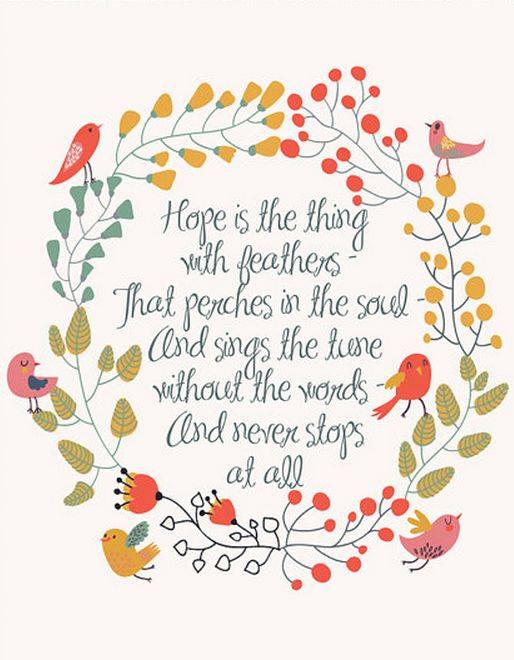
Beautiful words of wisdom to keep in mind, from Emily Dickinson –
Hope is the thing with feathers
That perches in the soul
And sings the tune without the words
And never stops at all
Two hopeful good news ‘things with feathers’ happenings to share – The Piping Plovers of Moonlight Bay was awarded the Best Feature Documentary at the Queen City Film Festival. I am looking forward to sharing the news with my father- and sister-in-law, and my husband’s entire family because they all live in, or come from, Cincinnati!
Even though we gave the location of the film a fictional name, Moonlight Bay, the locations look a great deal like north of Boston/Atlantic coast beaches. One of my greatest hopes for our Plover documentary is that it would have universal appeal, that people of all ages from regions across the country would find the film interesting. We are overjoyed audiences are finding it so!
The very day the news of the award came to my inbox, a story about Piping Plover chicks at the Cincinnati Zoo did as well. Three chick were hand-reared at the zoo this past summer. Due to nest abandonment, each summer a portion of Piping Plover eggs are rescued from their natural habitat. Zookeepers from around the country work to hatch and rear the chicks in a project created by the Detroit Zoo. Volunteers monitor wild nests closely and if they find eggs in need of attention, they collect and deliver the eggs to the hand-rearing facility. This season, a total of 22 chicks were hatched out. The three hand-reared chicks at the Cincinnati Zoo were successfully returned to the wild.
The Atlantic Coast Piping Plovers are on the threatened species list however, the Great Lakes Plovers are at even greater risk. Great Lakes Plovers are listed as endangered. When the Great Lakes Plovers were given the ESA listing in 1984, there were only 12 Great Lakes pairs remaining. 2024 was a record year for GLPlover, with 78 pairs successfully fledging 122 wild chicks.
We are making headway in our grant writing and fundraising efforts and I hope to have some good news to share with you soon. In the meantime, I would like to thank once again all our friends who have donated so generously. Without your kind help, we would not be nearly as far along in production and in film festival submissions. Thank you.
With gratitude to the following PiPl friends for their kind contributions – Lauren Mercadante (New Hampshire), Jane Alexander (New York), Cornelius Hauck (Cincinnati), Sally Jackson (Gloucester), Cape Ann Garden Club, Brace Cove Foundation (Gloucester), JH Foundation/Fifth Third Bank (Ohio), Janis and John Bell (Gloucester), Jennie Meyer (Gloucester), Alice and David Gardner (Beverly), JoeAnn Hart (Gloucester), Kim Tieger (Manchester), Joanne Hurd (Gloucester), Holly Niperus (Phoenix), Bill Girolamo (Melrose), Claudia Bermudez (Gloucester), Paula and Alexa Niziak (Rockport), Todd Pover (Springfield), Cynthia Dunn (Gloucester), Nancy Mattern (Albuquerque), Marion Frost (Ipswich), Cecile Christianson (Peabody), Sally Jackson (Gloucester), Donna Poirier Connerty (Gloucester), Mary Rhinelander (Gloucester), Jane Hazzard (Georgetown), Duncan Holloman (Gloucester), Karen Blandino (Rockport), Duncan Todd (Lexington), Sue Winslow (Gloucester), Amy Hauck-Kalti (Ohio), JoAnn Souza (Newburyport), Karen Thompson (San Francisco), Carolyn Mostello (Rhode Island), Susan Pollack (Gloucester), Peggy O’Malley (Gloucester), Hilda Santos (Gloucester), Maggie Debbie (Gloucester), Sandy Barry (Gloucester), The Massachusetts Daughters of the American Revolution, Mary Keys (Madeira, Ohio), Barbara Boudreau (Gloucester), Suki Augusti (Rockport), Jonathan and Sally Golding (Gloucester), Sue Winslow (Gloucester), Cecile Christensen (Peabody), Marty and Russ Coleman (Dallas), David Brooks (Troy, Michigan), Karen Maslow (Gloucester), Lisa Craig (Winchester), Menotomy Bird Club (Winchester), Lyda Kuth (Belmont), and, my as always, wonderfully supportive husband, Tom ❤
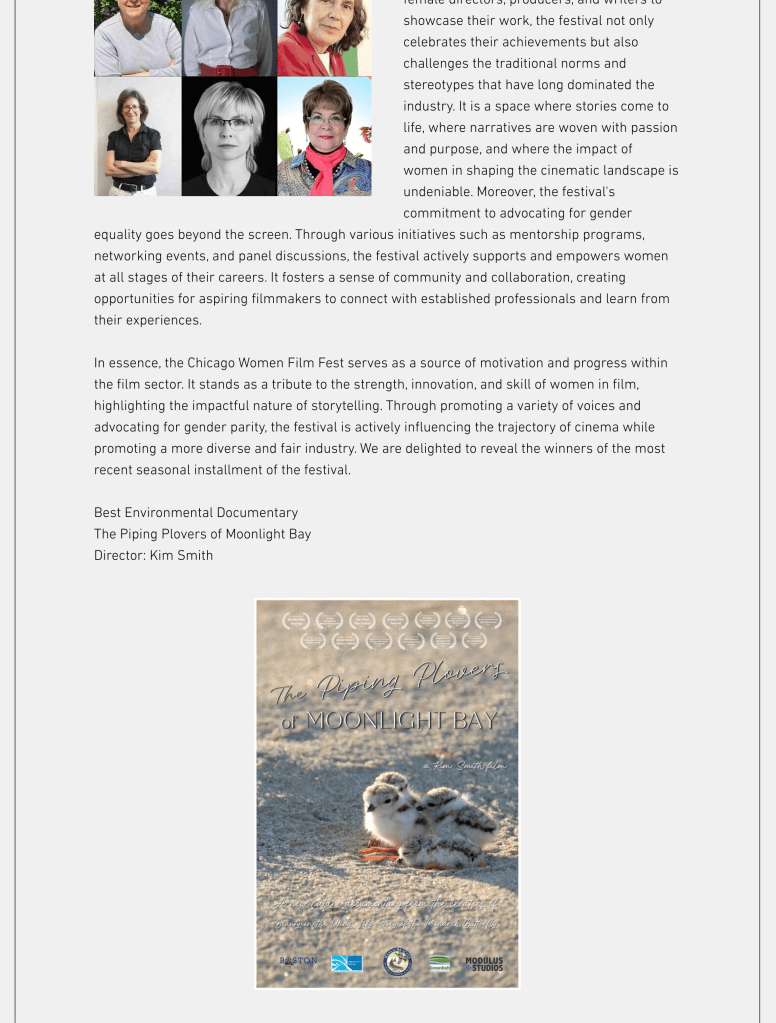
Knowing of Chicagoans great love for the Montrose Bay Piping Plovers Monty and Rose (and their offspring Imani and Nagamo), I applied to several festivals in the Great Lakes region. We are delighted to post that last week The Piping Plovers of Moonlight Bay was accepted to the Chicago Women Film Festival. I was planning to share that when we just received notice that The Piping Plovers of Moonlight Bay has been awarded the Best Environmental Film at the CWFF. In case you have PiPl friends in the area that may be interested in attending, as soon as we know when it is going to screen at the festival, we’ll let you know.
Thank you for this tremendous honor Chicago Women Film Festival!
We are also very excited to share that we have been nominated to the Montreal Independent Film Festival.
The Piping Plovers of Moonlight Bay is an official selection and/or award winner at the following festivals:
Boston Film Festival – Eco Film Award Chicago Women’s Film Festival- Best Environmental Documentary F3: Queen City Film Festival – Best feature Documentary Cine Paris Film Festival – Best Family Friendly Film Boston International Kids Film Festival Montreal Independent Film Festival Dumbo Film Festival San Diego International Kids Film Festival Berlin Women Cinema Festival France USA International Film Festival Toronto International Film festival Nature Without Borders Film festival International Motion Picture Awards Documentaries Without Borders Film Festival WPRN Women’s International Film Festival Newburyport Documentary Festival (withdrawn due to scheduling conflict)










 The Piping Plover Project