Tag Archives: Carolyn Mostello

Plover Rescue!

Our Plover partners at Audubon received a call over the weekend that there was a Piping Plover at Coffins Beach with a broken wing. Plover Ambassador Deborah B located the Plover yesterday afternoon and Charlotte and I headed over to Coffins.  Sure enough, its left wing was dragging on the ground but it appeared otherwise in good shape, foraging and running the length of the beach.  It also seemed very bonded with another Plover, possibly a sibling.

Through Carolyn Mostello, the Massachusetts Coastal Waterbird Biologist with Mass Wildlife, we received clearance to rescue the Plover. Because Plovers are listed as a threatened species there are specific protocols that must be followed before handling the bird. Next we needed to get the go ahead from Tufts Wildlife Clinic that they could at this time accept the Plover.

After the all clear, Lis Kernan , Mass DCR Shorebird Recovery Program Coordinator, and I met at Coffins. We quickly found the Plover. Lis had brought two nets and she expertly guided me on how we could safely steer the bird into the nets. She was soooo fast and in no time, the bird was safely tucked into a waiting cardboard box outfitted with a soft towel, as was recommended by local wildlife rehabber Jodi Swenson from Cape Ann Inc..

As I was driving the little one to Tufts Wildlife Clinic in Grafton he/she began piping. It wasn’t the sharply piercing warning call Plovers make when stressed but the gentle sing-song piping that we hear when they are communicating with one another. I think it was calling to see if there were other Plovers in the vicinity. I responded (with words, not piping) and we seemed to have a back and forth conversation but then I wanted it to conserve its energy and stop piping. I tried singing lullabies to see if that would soothe its little soul, but he kept piping all along until the car stopped.

A very kind staff member, Patrick, was waiting at the clinic. He provided us with a case number so that we can check in periodically. If all goes well, it should take about three weeks for the broken wing to heal and then several more weeks to learn how to fly. I am afraid it will miss peak migration and see a road trip to North Carolina in our future 🙂

As Jamie from Audubon mentioned, today was a great example of cross-organization collaboration to help an injured creature.

Above photos courtesy Lis Kernan

Massachusetts is Leading the Way in Piping Plover Recovery – Outstanding Coastal Waterbird Cooperators’ Meeting!

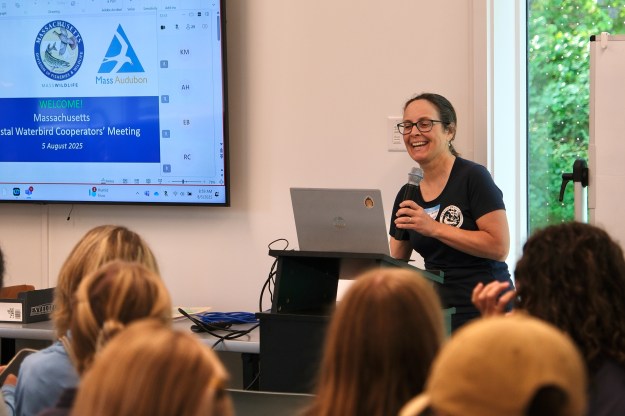
Carolyn Mostello, the Massachusetts Coastal Waterbird Biologist

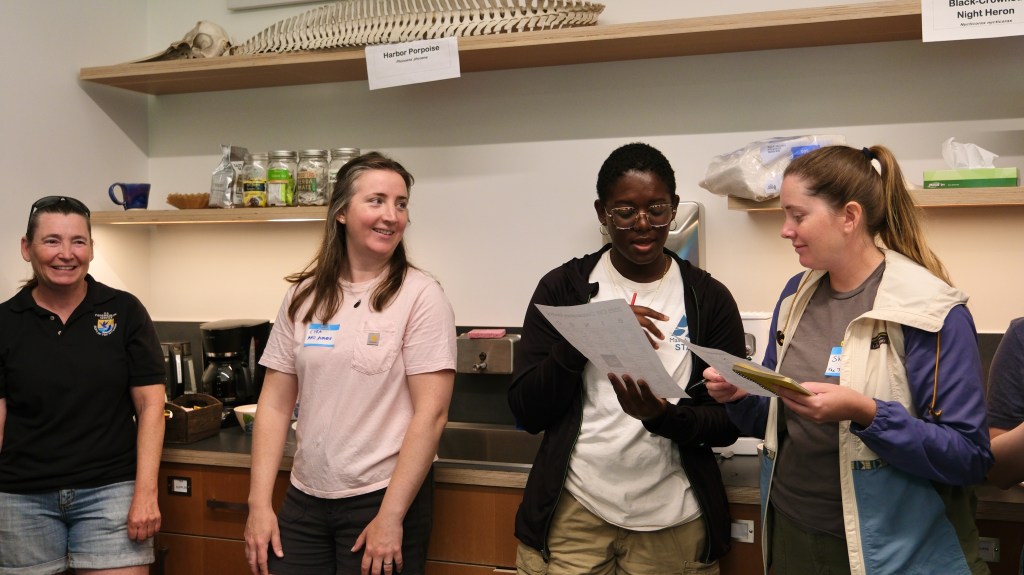
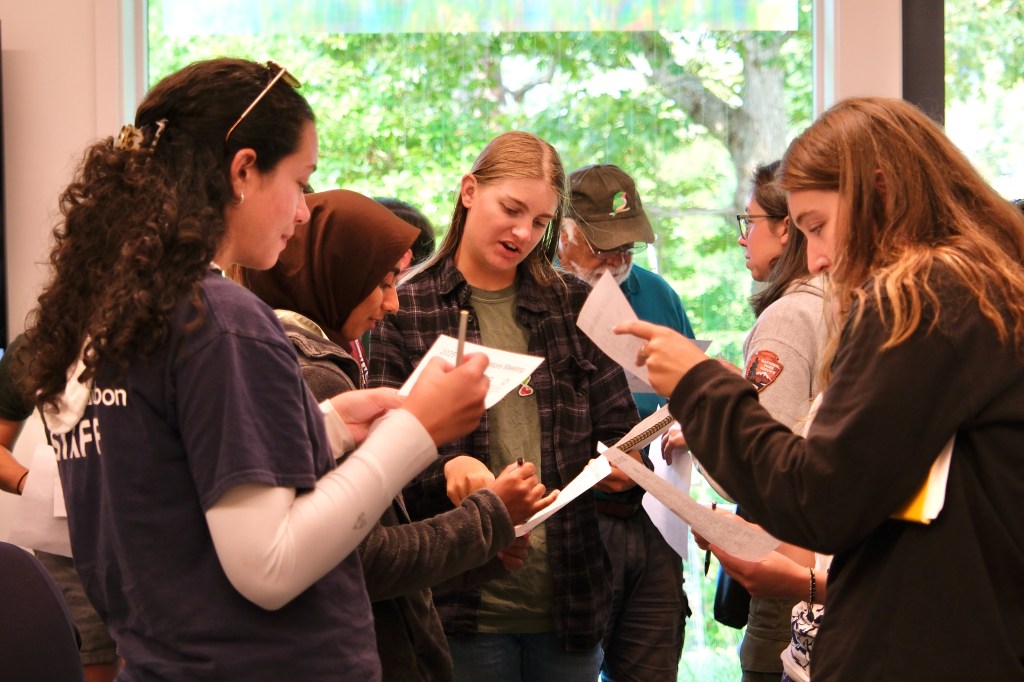
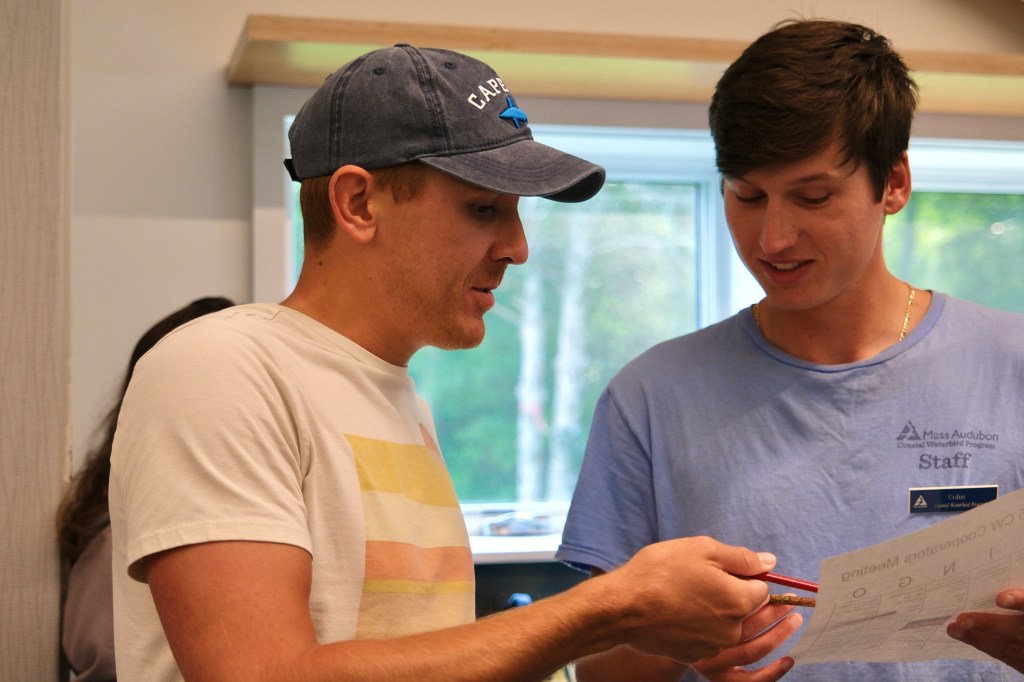
Last week I has the opportunity to attend the Massachusetts Coastal Waterbird Cooperators’ Meeting. The meeting is held annually to bring together people and organizations that are involved with population monitoring and conservation efforts on behalf of coastal waterbirds.

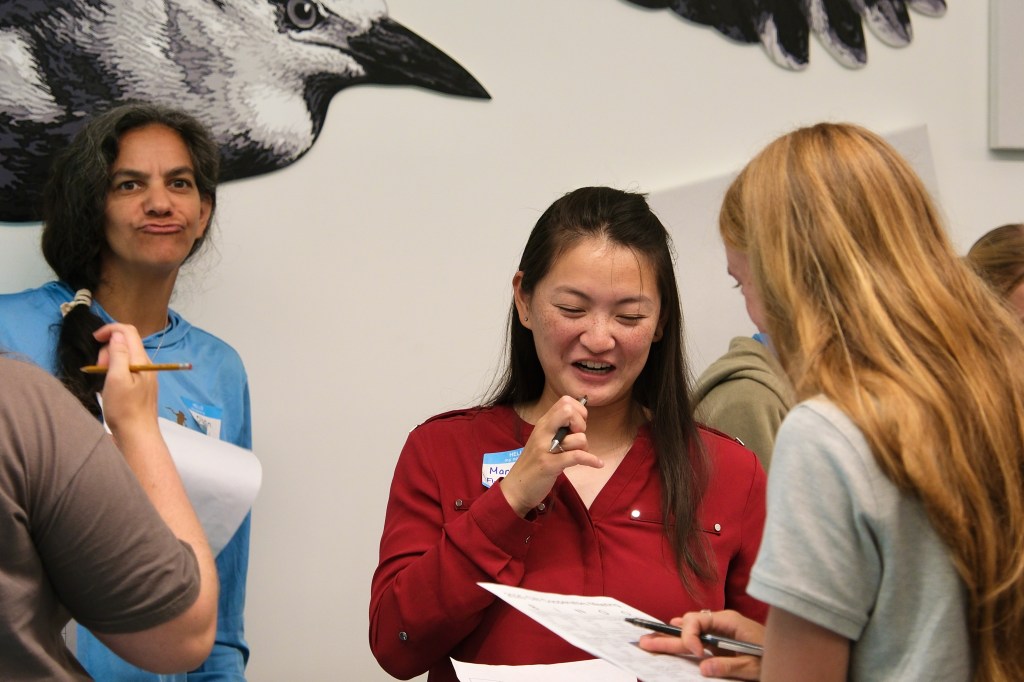
Representatives from the seven Massachusetts coastal regions gather to share information, anecdotes, and data collected throughout the season. This year the meeting was held at Audubon’s stunning Barnstable Great Marsh Wildlife Sanctuary; hosted by Audubon staff and Carolyn Mostello, the Massachusetts Coastal Waterbird Biologist.

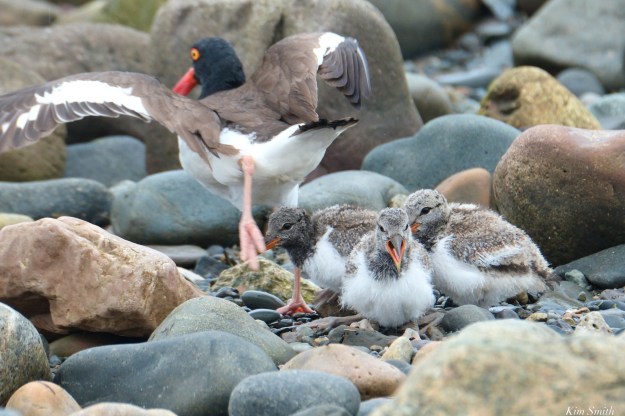
American Oystercatcher chicks

Threatened and endangered species such as Least Terns, Piping Plovers, Roseate Terns, and American Oystercatchers are given the greatest attention.

It’s fascinating to learn how we are all sharing similar experiences including egg predation by Crows, gulls, and Coyotes, disturbances of all shapes and kinds, low egg hatching, and storm washouts. Carolyn directs the event and she does an extraordinary job of weaving all the information together.

Reporting population numbers is followed by “Strange and Unusual,” a super fun section where field agents share funny/odd occurrences, photos, and videos. A special tribute was given to honor Shiloh Schulte, who perished in a tragic helicopter crash while studying shorebirds in Alaska. Shiloh Shulte was a beloved friend and mentor to shorebird conservationists every where and one of the  coordinators for the American Oystercatcher Recovery Program. You can read more about Shiloh and his work HERE.

The afternoon programs are especially interesting with presenters sharing experiments, projects, and best practices, including two of special interest to our region; one on launching in-depth data collection on fireworks, and best practice for engaging with landowners. All the programs are wonderfully educational.

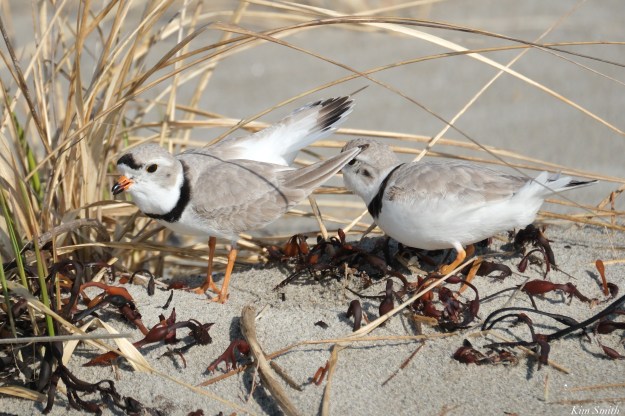
Handicapped Mom and Super Dad’s second attempt at nesting

Handicapped Mom and Super Dad’s second attempt at nesting

Despite an extremely challenging year, largely due to the fact that most of the nests around the State were washed out in a late spring storm, perhaps the most outstanding take-away is that this year again, Massachusetts is at the leading edge edge of Piping Plover recovery.  We should be super proud of our state. While many regions are seeing very little, none, or even worse, declining numbers, Massachusetts is leading the way in Piping Plover recovery!

CONGRATULATIONS TO MASSACHUSETTS WITH 1,100 PAIRS OF PIPING PLOVERS – OUTSTANDING COASTAL WATERBIRD COOPERATORS MEETING!

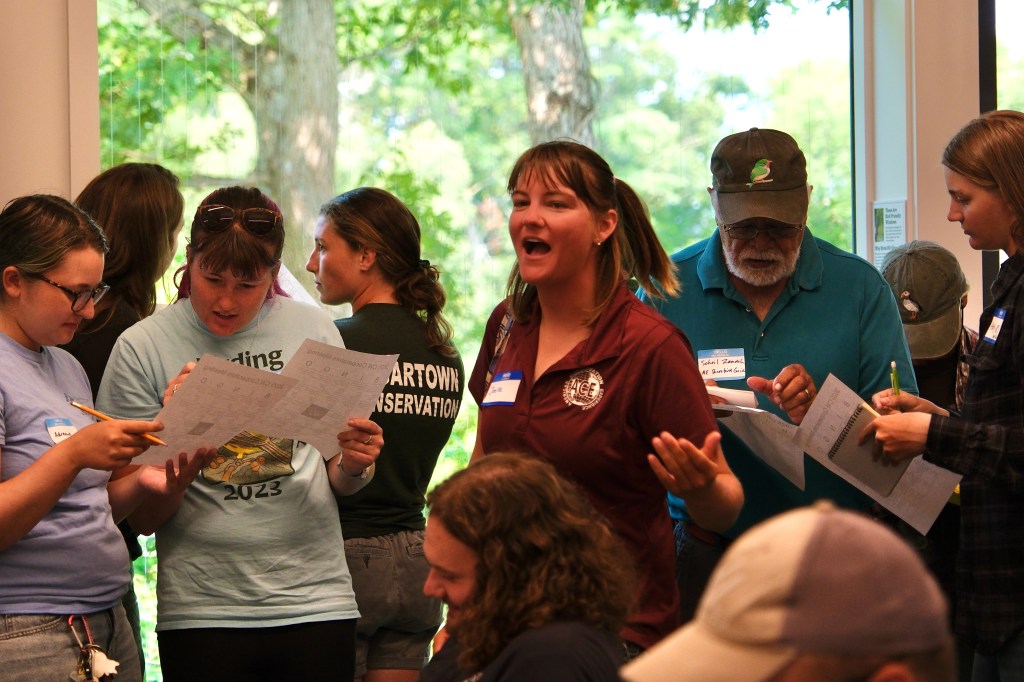
The annual Northeast Coastal Waterbird Cooperators meeting was held live last week in Barnstable at Cape Cod Community College’s new science and engineering center. After several years of attending virtually, it was a joy to meet in person.

Conservation organization’s representatives from all eight Massachusetts coastal regions, along with representatives from New Jersey, New York, Connecticut, Rhode Island, New Hampshire, and Maine share numbers and anecdotes about breeding pairs of endangered and threatened shorebirds including Piping Plovers, Least Terns, American Oyster Catchers, Roseate Terns, and Black Skimmers. It’s fascinating to learn how we are largely all sharing similar experiences with predators and disturbances of all shapes and kinds. Carolyn Mostello, the Massachusetts Coastal Waterbird Biologist, directs the event and she does an extraordinary job of weaving all the information together.

Sharing numbers is followed by “Strange and Unusual,” a super fun section where field agents share funny/odd occurrences, photos, and videos for example, PiPl nests with five eggs, strangely colored and oddly shaped eggs, parking lot nesters, and more. Carolyn shared the trailer for my forthcoming film, The Piping Plovers of Moonlight Bay, and I am happy to share that it was very much enjoyed by the attendees!

The afternoon programs are especially fascinating with presenters sharing experiments and projects including two of special interest; one on using odors to deter mammalian predators and another with music and different sounds to deter Black-crowned Night Herons from eating shorebird eggs. All the programs are wonderfully educational.

Perhaps the most outstanding piece of information is that this year, Massachusetts was home to 1100 breeding pairs of Plovers. That may not sound like a whole heck of a lot considering our hundreds of miles of coastline, but 1,000 pairs has been a long held goal of shorebird recovery programs in Massachusetts. We should be super proud of our state. While many regions are seeing very little, none, or even worse, declining numbers, Massachusetts is leading the way in Piping Plover recovery!

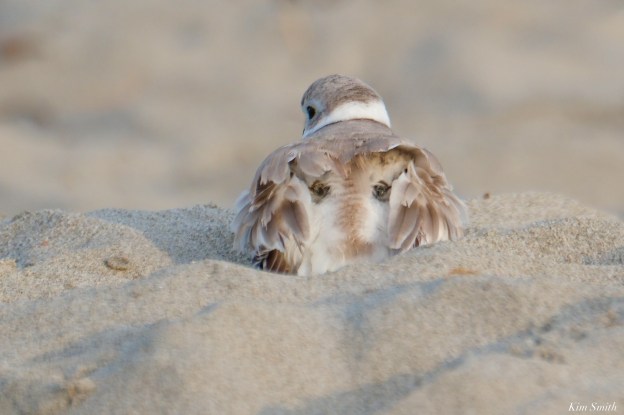
Smooshed!

1033 PAIRS OF PLOVERS WITH 1,330 CHICKS FLEDGED!!!

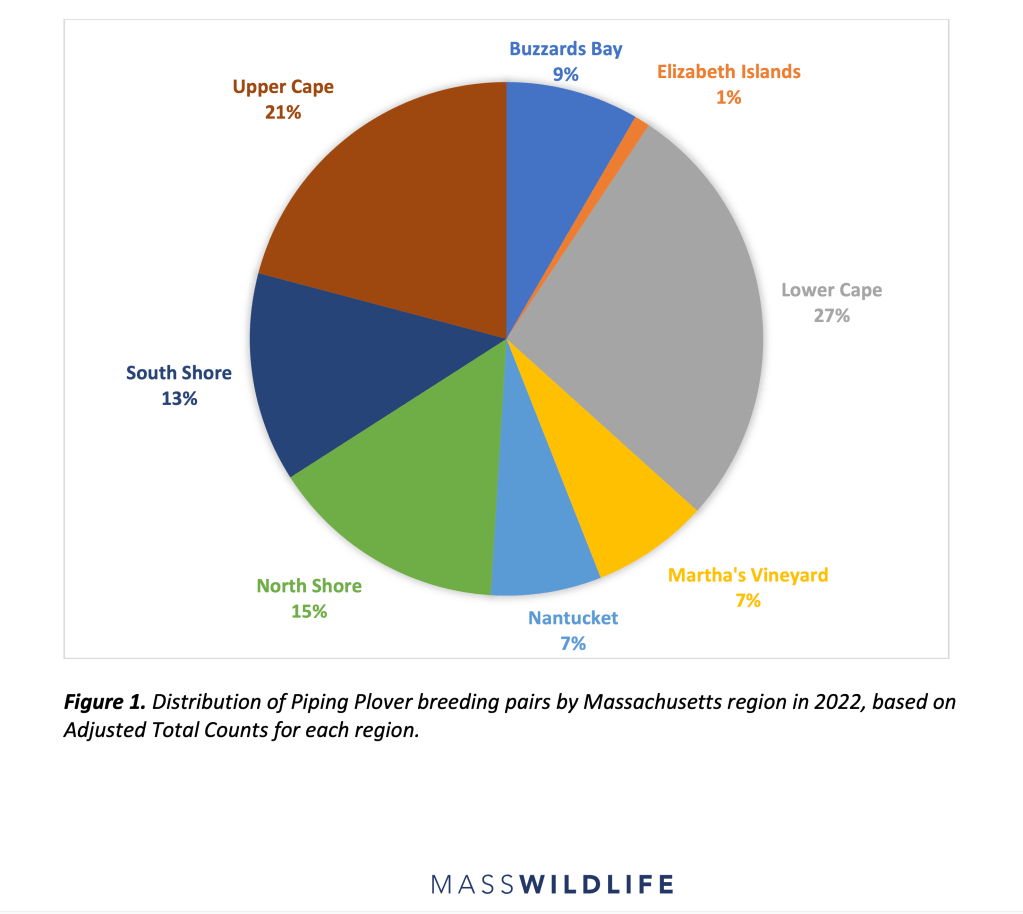
We have received outstanding news from our Massachusetts Coastal Waterbird Biologist, Carolyn Mostello. She shared the” Summary of the 2022 Massachusetts Piping Plover Census.” The grand total for Massachusetts breeding pairs of Plovers is a whopping 1033, up 6.8 percent relative to 2021. A total of 1,330 chicks was reported fledged for an overall productivity of 1.31 fledglings per pair.

The summary is prepared each year by the Natural Heritage and Endangered Species Program, a division of Mass Wildlife. The Summary is in pdf form and I am happy to email anyone the report if you are interested. Please leave a comment in the comment section and your email will pop up on my end. Thank you for your interest!

The following are some highlights from the Summary –

ABSTRACT

This report summarizes data on abundance, distribution, and reproductive success of Piping Plovers (Charadrius melodus) in Massachusetts during the 2022 breeding season. Observers reported breeding pairs of Piping Plovers present at 209 sites; 150 additional sites were surveyed at least once, but no breeding pairs were detected at them. The population increased 6.8% relative to 2021. The Index Count (statewide census conducted 1-9 June) was 1,013 pairs, and the Adjusted Total Count (estimated total number of breeding pairs statewide for the entire 2022 breeding season) was 1,033 pairs. A total of 1,330 chicks was reported fledged in 2022, for an overall productivity of 1.31 fledglings per pair, based on data from 98.6% of pairs.

INTRODUCTION

Piping Plovers are small, sand-colored shorebirds that nest on sandy beaches and dunes along the Atlantic Coast from North Carolina to Newfoundland. The U.S. Atlantic Coast population of Piping Plovers has been federally listed as Threatened, pursuant to the U.S. Endangered Species Act, since 1986. The species is also listed as Threatened by the Massachusetts Division of Fisheries and Wildlife pursuant to the Massachusetts’ Endangered Species Act.

Population monitoring is an integral part of recovery efforts for Atlantic Coast Piping Plovers (U.S. Fish and Wildlife Service 1996, Hecht and Melvin 2009a, b). It allows wildlife managers to identify limiting factors, assess effects of management actions and regulatory protection, and track progress toward recovery. In this report, we summarize data on abundance, distribution, and reproductive success of Piping Plovers breeding in Massachusetts in 2022, as observed and reported by a coast-wide network of cooperators.

METHODS

Monitoring and management of Piping Plovers and other coastal waterbirds in Massachusetts is carried out by wildlife biologists, seasonal shorebird monitors, beach managers, researchers, and volunteers affiliated with over 20 federal and state agencies, local municipalities, local and regional land trusts, private conservation organizations, and universities. Cooperators monitored 359 sites in Massachusetts in 2022 for the presence of breeding Piping Plovers.

 *     *     *

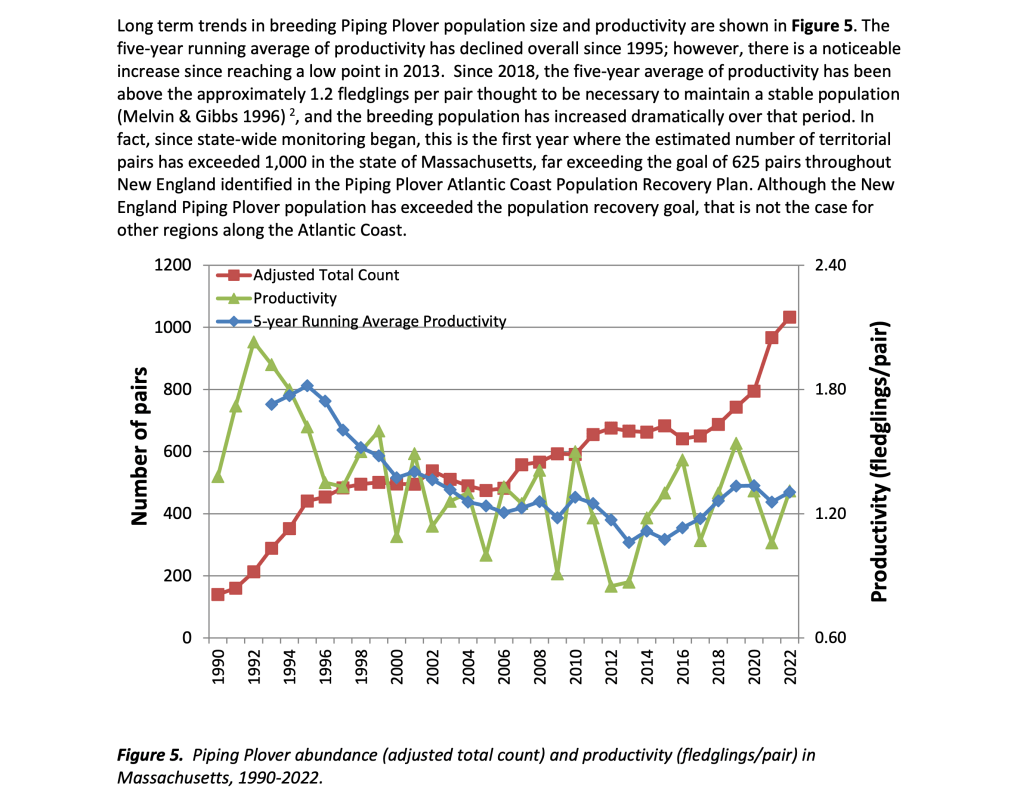
Long term trends in breeding Piping Plover population size and productivity are shown in Figure 5. The five-year running average of productivity has declined overall since 1995; however, there is a noticeable increase since reaching a low point in 2013. Since 2018, the five-year average of productivity has been above the approximately 1.2 fledglings per pair thought to be necessary to maintain a stable population (Melvin & Gibbs 1996) 2, and the breeding population has increased dramatically over that period. In fact, since state-wide monitoring began, this is the first year where the estimated number of territorial pairs has exceeded 1,000 in the state of Massachusetts, far exceeding the goal of 625 pairs throughout New England identified in the Piping Plover Atlantic Coast Population Recovery Plan. Although the New England Piping Plover population has exceeded the population recovery goal, that is not the case for other regions along the Atlantic Coast.