This annual festival takes place at the Bay of Somme and is not only a film festival but a magnificent celebration of the natural world. There are over 400 guided walks, photo and art exhibits, screenings of the best nature documentaries, activities dedicated to children such as workshops and shows, debates, and conferences.
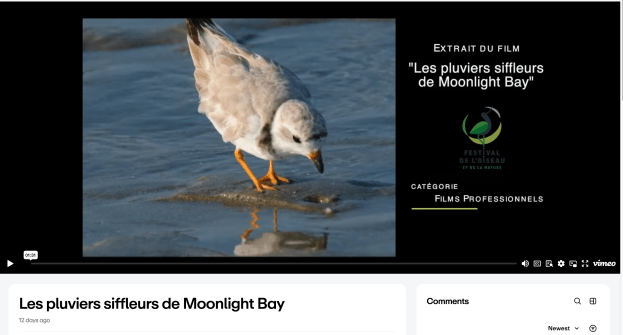
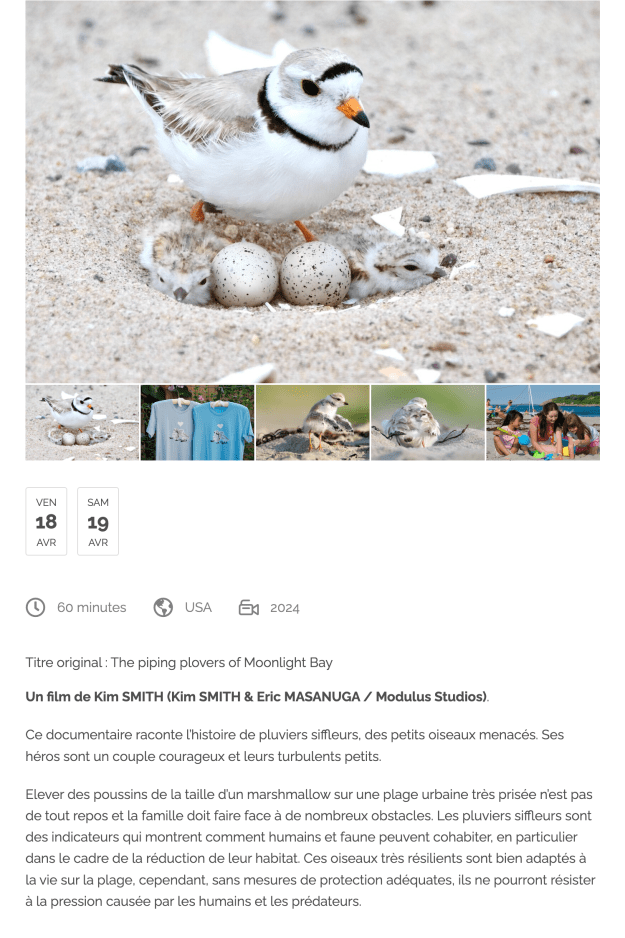
Ce documentaire raconte l’histoire de pluviers siffleurs, des petits oiseaux menacés. Ses héros sont un couple courageux et leurs turbulents petits.
Elever des poussins de la taille d’un marshmallow sur une plage urbaine très prisée n’est pas de tout repos et la famille doit faire face à de nombreux obstacles. Les pluviers siffleurs sont des indicateurs qui montrent comment humains et faune peuvent cohabiter, en particulier dans le cadre de la réduction de leur habitat. Ces oiseaux très résilients sont bien adaptés à la vie sur la plage, cependant, sans mesures de protection adéquates, ils ne pourront résister à la pression causée par les humains et les prédateurs.
See what Los Angeles PBS has to say about our film!
The Piping Plovers of Moonlight Bay airs Tuesday, April 15 at 8 PM
“Against the ever-changing tides of the Atlantic, a tiny but mighty family fights for survival. The Piping Plovers of Moonlight Bay follows a devoted pair of these rare shorebirds as they raise their marshmallow-sized chicks on a bustling urban beach. Every day is a test of their resilience—avoiding predators, braving unpredictable weather, and navigating a world where humans and wildlife collide. Will their fragile brood make it to adulthood?
This heartwarming and visually stunning special takes you inside the incredible journey of one of nature’s most determined parents. Witness breathtaking moments of survival and the deep bonds that keep these feathered families together. A story of hope, adaptation, and the delicate balance of our ecosystems.
Tune in for an unforgettable look at one of nature’s most compelling underdog stories. Sometimes, the smallest creatures have the most powerful stories to tell.”
California Friends, please check listings as The Piping Plovers of Moonlight Bay is airing at your local stations – KCET, KOCE, KVCR, KPJK, KQED, KQEH, KRCB, and KVPT.
Film screenings are designed to be presented to conservation organizations, schools, libraries, clubs, and special events for both private and public groups.
Film Screening and Q&A with the Director, Kim Smith
The Piping Plovers of Moonlight Bay
Discover how we can all become stewards of these pocket-sized, endangered shorebirds.
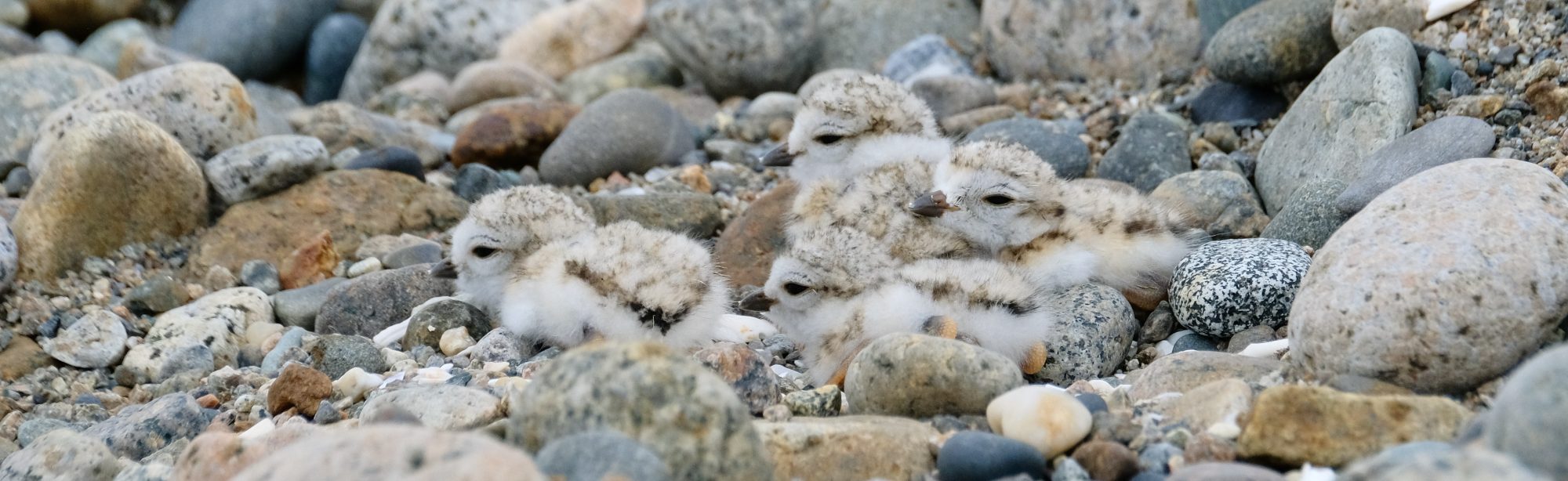
Synopsis:The Piping Plovers of Moonlight Bay is a one-hour nature documentary that tells the life story of these captivating and endangered birds. The film features a pair of courageous Plovers and the adventures of their blended brood of chicks. Raising tiny, marshmallow-sized baby birds on a crowded urban beach is a perilous occupation and the family overcomes many life-threatening obstacles.
Piping Plovers are a bellwether species that speaks to how successfully wildlife and people interact with one another, especially in light of the growing threat of habitat loss. These remarkably resilient birds are well adapted to life on the beach however, without adequate protective measures, Piping Plovers will fail in the face of pressure created by people and predators.
We are inspired by the beauty of the Plover’s life story and also highly aware of the formidable challenges these valiant little birds face at every stage of life
For schedule a screening, please contact Kim Smith at kimsmith.designs1@gmail.com and visit the film’s website here: The Piping Plover Project
Checkout this lovely graphic created for us at American Public Television for our release on PBS! Beginning today, April 1st, The Piping Plovers of Moonlight Bay is airing on public television. Please check your local listings for times.
As a Passports member, you can also stream the film at anytime. We find our family’s membership to PBS invaluable; the programming is stellar and costs a fraction of any other streaming service, just $5.00 per month. We are members of New Hampshire PBS, which is also one of the 290 stations nationwide airing The Piping Plovers of Moonlight Bay. Here is the link on how to join: https://nhpbs.org/watchmore/
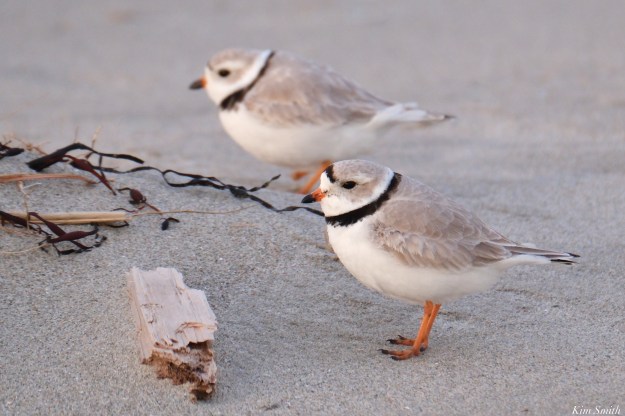
We have wonderful news to share. Our Good Harbor Beach Piping Plovers are returning! Not only that, but the original pair that have been nesting at GHB since 2016 were the first to arrive. Both Mom and Dad appeared on the very same day, March 19th, the earliest date ever. At this time of year, my husband and I check the beach daily so that we can track from year to year when Plovers begin arriving. Last year I believe it was March 25th.
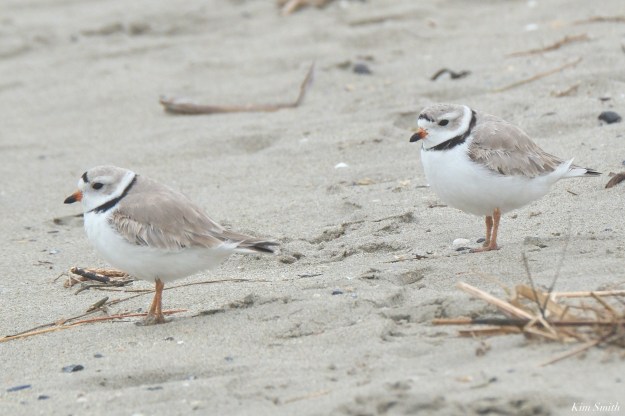
Super Dad and Handicapped Mom, March 19, 2025
A Plover love story for the ages is how my friend Todd describes it when Plover pairs nest together for many years. These two sweet Plovers must be at a minimum of 11 years old because Plovers don’t begin breeding until they are at least one year old. Eleven years is quite a ripe old age for Plovers as most live on average only five years. We wait with a combination of fear and excitement each spring, hoping and praying our Plover family makes it through another winter, especially now that Mom’s right foot is missing. She lost her foot several years ago after nylon fishing line and seaweed became tightly wound around her lower leg.
When you think about it, we have been through so much with this little Mom and Dad. The first several years especially were extremely challenging. Beachgoers did not yet understand how to help protect the birds and pets had the run of the beach. In fact, conditions were so bad on the beach that in 2018 Mom and Dad decided ‘enough with dog disturbances,’ and the safest place to nest was the GHB parking lot. Because of this, Massachusetts State and US Federal wildlife officials became heavily involved with helping to protect Gloucester Plovers and the local government began to take Plover protections more seriously. Little by little, things began to change for the better.
I remember our tender little handicapped Plover, nicknamed HipHop for his gimpy walk. It was Mom’s first season breeding without her right foot and she was extremely clumsy when transitioning to get in and out of the nest and when she was snuggling the chicks. I think she must have injured HipHop somehow because his injury manifested itself when he was about ten days old. Mother and chick were quite the pair with their hip hopping gaits. We thought HipHop would never grow to the size of his siblings and wondered if he would ever be able to fly. Mom departed early as is not unusual for females to begin migrating before their mates. Our Super Dad stayed with HipHop for many weeks after and throughout the entire summer. Both departed around the beginning of September, but not until HipHop was flying just as well as his siblings.
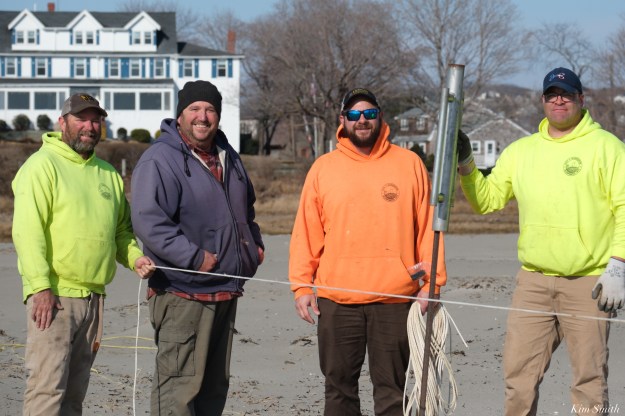
Dean Horne, Brian Watson, John Trupiano, and Adam Kelley installing Piping Plover protections
Thank you to the Gloucester DPW crew for installing the symbolic ropes and Plover signs. We appreciate everything the DPW does to keep Plovers safe and our local beaches looking beautiful!
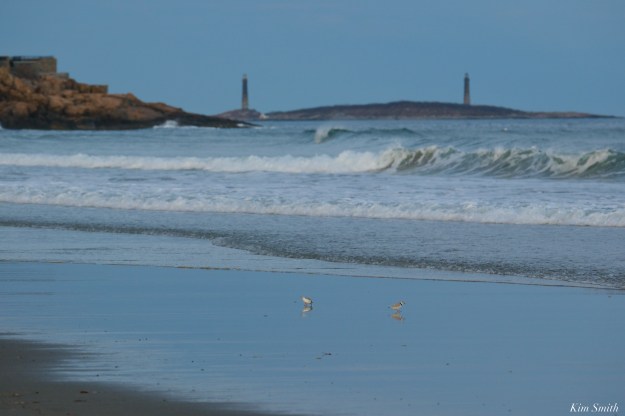
If you happen to see Plovers on the beach, please give them lots and lots of space. Know that they are weary from the long migration and need to rest and refuel before ‘setting up house.’
Piping Plovers are returning to beaches all along the Atlantic Coast. The addendum to this note is for several new Plover friends from beaches in Maine and New Jersey who have written to ask how they can better help their community’s Plover families successfully fledge chicks.
Happy Spring from Ploverville!
Warmest wishes,
Kim
Actions that communities and beachgoers can take early in the season to help Plovers successfully breed include the following. I can not stress ‘early in the season’ enough. The earlier the Plovers nest without disturbances, the earlier they will begin laying eggs, and the earlier the chicks will fledge and begin migrating.
1) Disallow all pets on the beach, ideally beginning March 15th, April 1st at the latest.
2) Install symbolic roping around known Plover nesting areas by March 15th.
3) Install informational signage on beaches where Plovers nest by March 15th.
4) Do not permit off-road vehicles on beaches where shorebirds are nesting.
5) Do not rake the beach. Beach raking destroys a vital food source and machines can scoop up and kill chicks that can’t yet fly out of the way of danger.
6) Respect symbolically roped off areas. Do not play ball close to the roping. It is against state and federal law to run into the nesting area to retrieve a ball or for any other reason. Do not allow pets to run through the roped off areas and do not cross the roped off areas to take shortcuts through the dunes.
The Piping Plovers of Moonlight Bay was made possible by the generous contributions from the following – Jane Alexander (Nova Scotia), Applied Materials (Gloucester/Silicon Valley), Massachusetts Division of Fisheries and Wildlife, Garth and Linsay Gremainn (Cambridge), Cornelius Hauck (Cincinnati), Jennie Meyer (Gloucester), Sally Jackson (Gloucester), New England BioLabs (Ipswich), Cape Ann Garden Club, Brace Cove Foundation (Gloucester), JH Foundation/Fifth Third Bank (Ohio), Janis and John Bell (Gloucester), Alice and David Gardner (Beverly), JoeAnn Hart (Gloucester), Lauren Mercadante (New Hampshire), Kim Tieger (Manchester), Joanne Hurd (Gloucester), Holly Niperus (Phoenix), Bill Girolamo (Melrose), Claudia Bermudez (Gloucester), Paula and Alexa Niziak (Rockport), Todd Pover (Springfield), Cynthia Dunn (Gloucester), Nancy Mattern (Albuquerque), Marion Frost (Ipswich), Cecile Christianson (Peabody), Sally Jackson (Gloucester), Donna Poirier Connerty (Gloucester), Mary Rhinelander (Gloucester), Jane Hazzard (Georgetown), Duncan Holloman (Gloucester), Karen Blandino (Rockport), Duncan Todd (Lexington), Sue Winslow (Gloucester), Amy Hauck-Kalti (Ohio), JoAnn Souza (Newburyport), Karen Thompson (San Francisco), Carolyn Mostello (Rhode Island), Susan Pollack (Gloucester), Peggy O’Malley (Gloucester), Hilda Santos (Gloucester), Maggie Debbie (Gloucester), Sandy Barry (Gloucester), The Massachusetts Daughters of the American Revolution, Mary Keys (Madeira, Ohio), Barbara Boudreau (Gloucester), Suki Augusti, Jonathan and Sally Golding (Gloucester), Sue Winslow (Gloucester), Cecile Christensen (Peabody), Marty and Russ Coleman (Dallas, Texas), David Brooks (Troy, Michigan), Karen Maslow (Gloucester), Lisa Craig (Winchester), Menotomy Bird Club (Winchester), Lyda Kuth (Belmont), Kimberly Bouris (Gloucester), Alexandra and Jon Hardy (Gloucester), Jane Wulf (Rockport), August Mirabella (North Wales, PA), Gloucester Movement Arts, Tom Hauck, and viewers like you. Thank you!
Thank you to all who attended our documentary screening of The Piping Plovers of Moonlight Bay on Sunday afternoon. We had a terrific group of attendees, both very generous and wonderfully engaged in the Qand A following the screening. I loved discussing Plovers and filmmaking with our guests and appreciate so much everyone who took the time out of their busy schedules to come and support the film.
Many, many thanks to Sarah, MAGMA’s founder and director, for hosting the event. In addition to offering a range of youth and adult dance classes, MAGMA provides an exceptional space for the community. Sarah hosts a range of events including films, dance performances, and local musicians, from punk bands, to string quartets! See MAGMA’s upcoming events here.
A very special shout out to Piping Plover Ambassadors Jonathan and Sally for their continued support and kind generosity. They provided all the beverages, Jonathan made an excellent bartender, and they both made everyone feel very welcome.
I hope to see you Sunday at our film screening fundraiser. Refreshments will be provided and following the screening, we’ll have lots of good discussion and wonderful news to share.
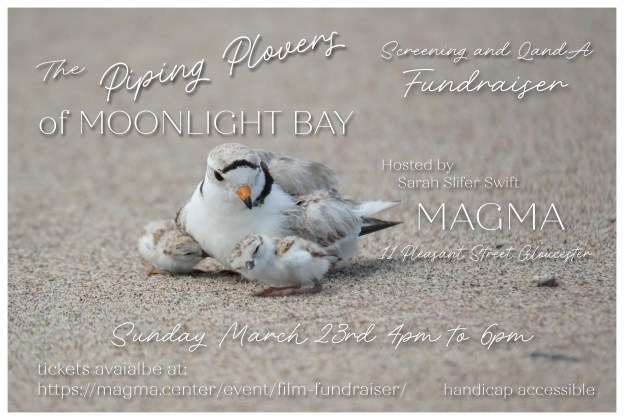
Although the postcard says handicapped accessible, unfortunately the elevator is now temporarily not working. Please let me know if you have purchased tickets and can no longer attend due to inaccessibility.
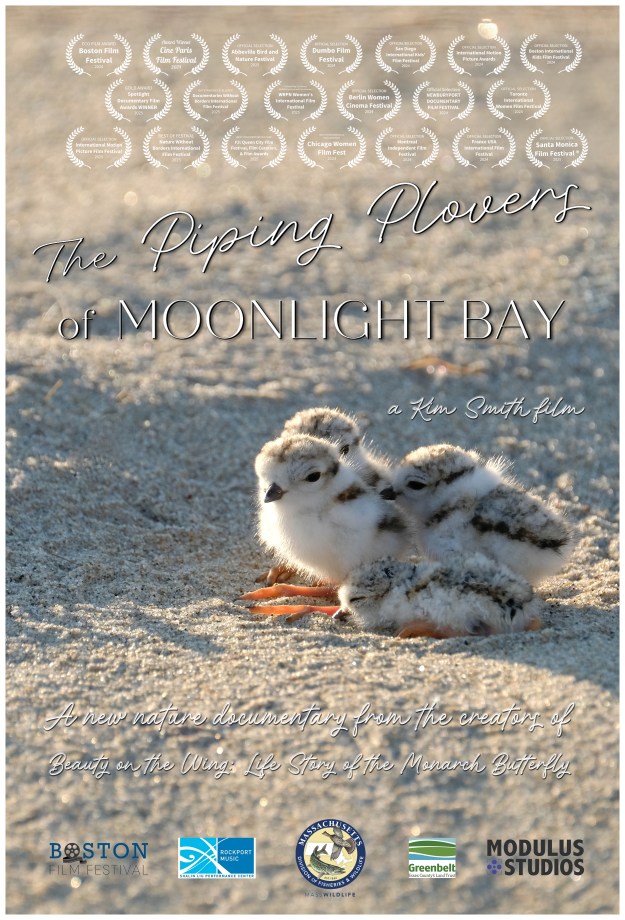
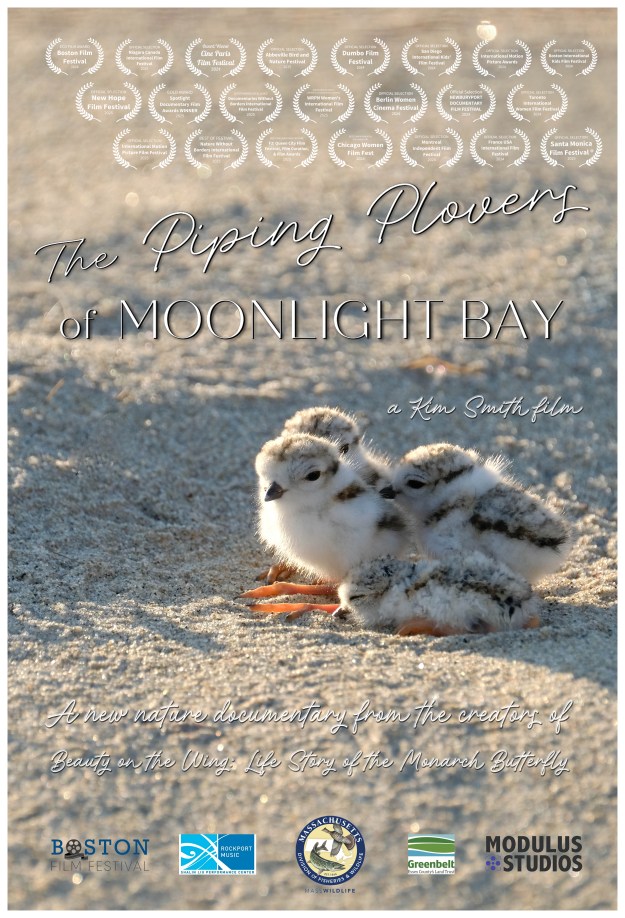
The Piping Plovers of Moonlight Bay is a 57-minute narrated documentary by Kim Smith that tells the story of the Piping Plover as it unfolds along the North Atlantic coastline. The film features a pair of courageous Plovers that overcome life-threatening obstacles while nesting at one of the region’s most popular beaches.
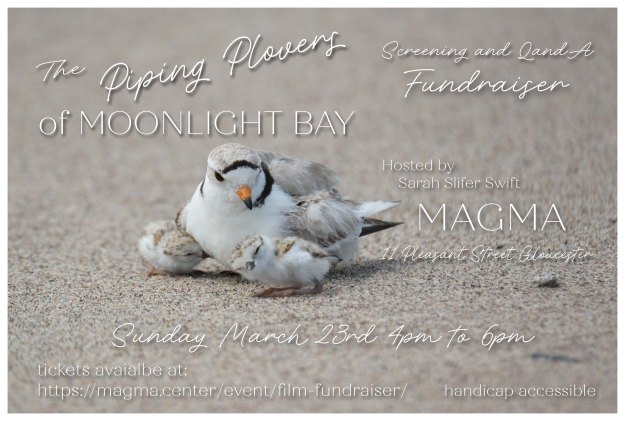
On Sunday March 23 at 4pm, MAGMA will host a fundraiser to help support the production and distribution of the film. This evening will include a showing of the film and a Q & A with filmmaker Kim Smith. Refreshments will be served. Suggested donation for this event is $50 (or what you can afford). For tickets please go here.
Each spring, northward migrating Atlantic coast Piping Plovers return to breeding sites located from North Carolina to Newfoundland. Amazingly, nesting often takes place on public beaches, where anyone can observe their beautiful life story unfolding. But in such areas, where people enjoy a full range of recreational activities, nesting and raising chicks is a perilous occupation.
Set against the backdrop of the ever-dynamic Atlantic shoreline, the documentary illustrates how conservation partners have provided safe corridors that allow these highly vulnerable birds to raise chicks to fledge at even the most well-loved beaches.
The Piping Plovers of Moonlight Bay is a film for all ages, and was created to inspire a love for wild creatures and their habitats, and to develop a deeper understanding of the vital role that wildlife play in our interconnected ecosystem.
Every stage of the Plover’s life cycle is experienced in vibrant HD and 4K close-up, from egg to chick to adult.
Production and distribution of The Piping Plovers of Moonlight Bay will be made possible by tax-deductible contributions from individuals, corporations, foundations, and public agencies.
To date, among other generous donations, we have received a leadership grant of $15,000 from the Massachusetts Division of Fisheries and Wildlife.
Gifts for The Piping Plovers of Moonlight Bay will support post production and distribution costs, color and sound editors, picture mastering, studio time, festival fees and applications, music and map rights, and an underwriting agent to bring the film to the wide audience of public television. Our goal is to raise $115,000.
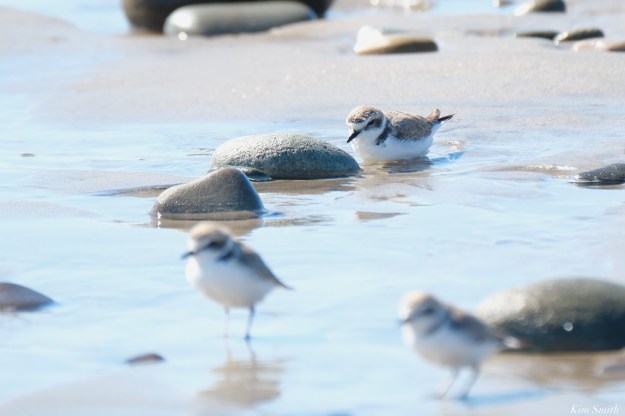
During my recent trip to Los Angeles, our daughter provided wonderful opportunities for us to take several joyous expeditions to see Western Snowy Plovers. I write joyous because we thought we would be fortunate to see one or two, when we actually saw severalhundred!
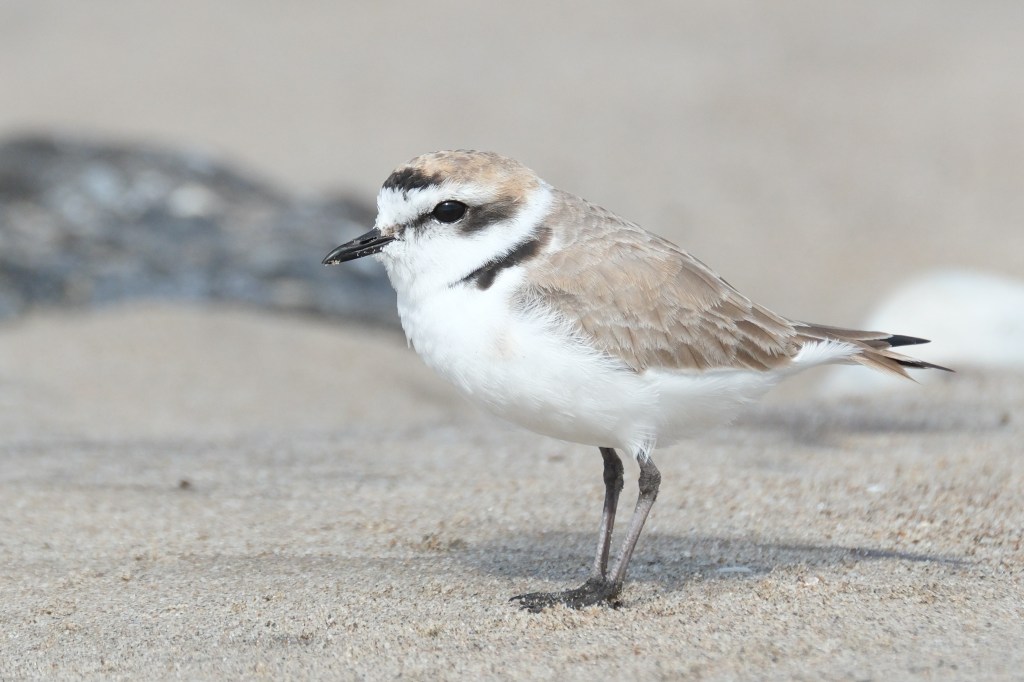
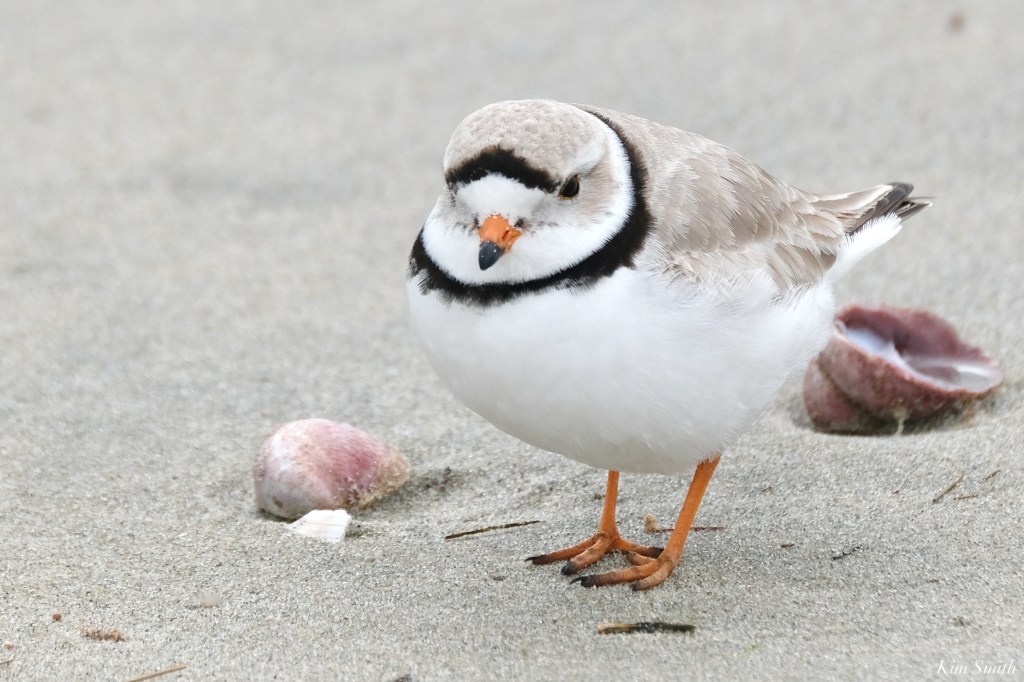
Snowy Plover (left), Piping Plover (right) – some key field mark differences at a glance – Snowy Plovers have black or gray legs, compared to the PiPls orange legs and feet; the beak of the SNPl is longer and solid black whereas the PiPls is beak is orange and black. Snowy Plover’s headband and collar band are not as pronounced. Piping Plovers lack the black eye patch.
We came across three breeding colonies; the largest was located on a relatively remote beach with an estuary bordering the northern end of the sandy dunes. We observed that Snowy Plovers share many similar traits to Piping Plovers including their love for invertebrates, both land and marine. PiPls and SnPl are visual feeders and utilize the “run-stop-peck” foraging method. Like Piping Plovers, Snowy Plovers display much territorial behavior towards one another and I imagine when the breeding season gets fully underway, there will be a great many more disputes.
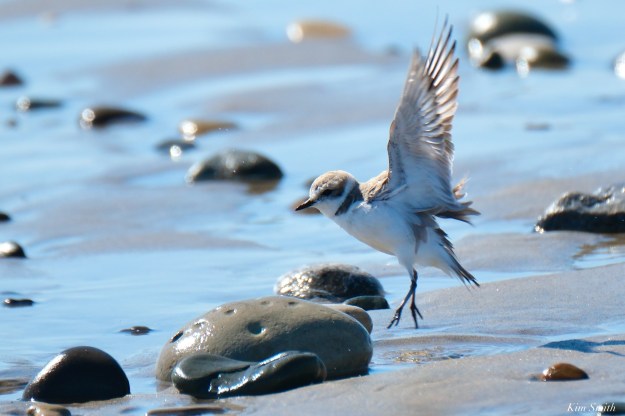
One notable difference is the Snowy Plovers communal “in-unison” bathing habit, which was absolutely charming to observe. A flock of 100 or so were foraging on kelp flies in the wrack when they all took off over the water, circling round several times in an exquisitely beautiful flight pattern before landing on the pebbly banks at the mouth of the estuary. After a few moments of seeming to observe whether it was safe or not to bathe, one by one they began entering the water, then in small groups, then even greater numbers joined the Plovers that were already in the water. Some were bathing singularly in the puddles made by rocks in the tide pools but for the most part, they were in the estuary creek dipping and splashing all along the banks. At one point I wasn’t entirely sure what was happening as they appeared to be continuing their onshore battles while they were bathing.
Snowy Plover drying wings after bathing
Another very notable difference is the bird’s vocalizations. The Snowy Plover’s song is more of a ta-wheet interspersed with sweet trilling chirps, rather than the penny whistle call of the Piping Plover. It was too windy to capture a really good audio recording, but you can hear the flock in the background of the bathing scenes in the video. To hear more variations in their birdsong, go here: Snowy Plover’s vocalizations.
Unlike Piping Plovers and many species of shorebirds, Snowy Plovers have no aerial flight display. Snowies also routinely have two broods, sometimes three, with three being the average number of eggs, as opposed to the PiPls four eggs. Typically about a week after hatching, mom pairs up with another male to begin establishing a second nest, leaving dad alone to raise the chicks.
Both Snowies and PiPls have similar predators including falcons, raccoons, coyotes, owls, crows, and ravens. And both species have been negatively impacted by extensive loss of habitat and human caused disturbances, most notably dogs crushing eggs and disturbing nesting areas. We observed volunteer docents at the nesting sites reminding scofflaw dog owners that dogs are not allowed at Snowy Plover breeding locations. California has approximately 3,400 miles of coastline and 420 state beaches. It’s unfortunate that despite the near limitless access of beaches to beachgoers that permit pets, dog owners still allow their dogs to run freely through the comparatively minuscule (area-wise) nesting sites.
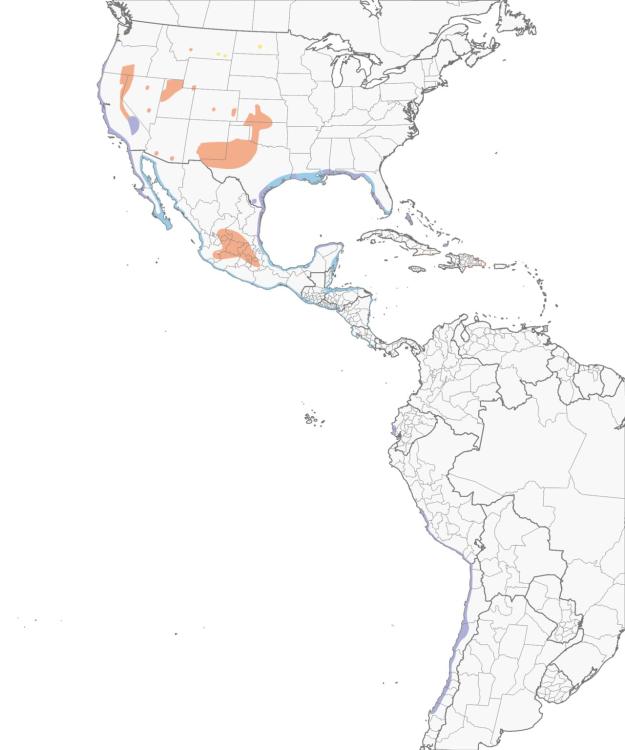
There are only about 2,000 Western Snowy Plovers that breed along California’s coast, from San Francisco to the Baja. The West Coast population is deemed a Threatened Species. At one time it was thought there were tens of thousands nesting at more than fifty breeding locations along the Pacific Coast. Today, there are only a handful of coastal nesting sites. Nationwide, there are approximately 24,000, compared to the total Piping Plover population, which is roughly 13,000 to 14,000 birds. You can also see Snowy Plovers along the Gulf Coast. Some nest there while others have migrated from their summer breeding grounds.
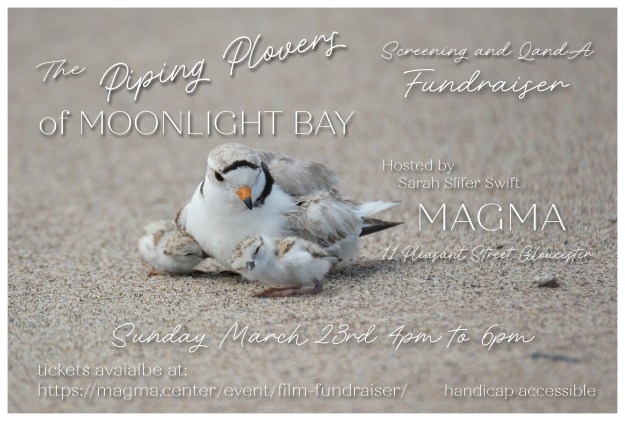
Please join us Sunday, March 23rd at 4pm, at MAGMA for a Piping Plover film screening and fundraiser. We’ll have much to talk about! Please R.S.V.P. and let us know if you are planning to come as we are providing refreshments. I hope to see you there!
Please join us Sunday afternoon, March 23rd, at 4pm, for a film screening and fundraiser for The Piping Plovers of Moonlight Bay. MAGMA Director Sarah Slifer Swift has very generously donated her lovely and spacious dance/event studio for our screening. A QandA with me will follow. We’ll talk about the film, community outreach plans for the upcoming Plover season, conservation status, and any other relevant topics you would like to discuss.
We’ll have refreshments, too. MAGMA is located at 11 Pleasant Street, Suite 64, in Gloucester, with elevator handicap accessibility.



 The Piping Plover Project