This article popped up in my news feed and although its from last summer I thought it a good read (or listen, if you prefer). –
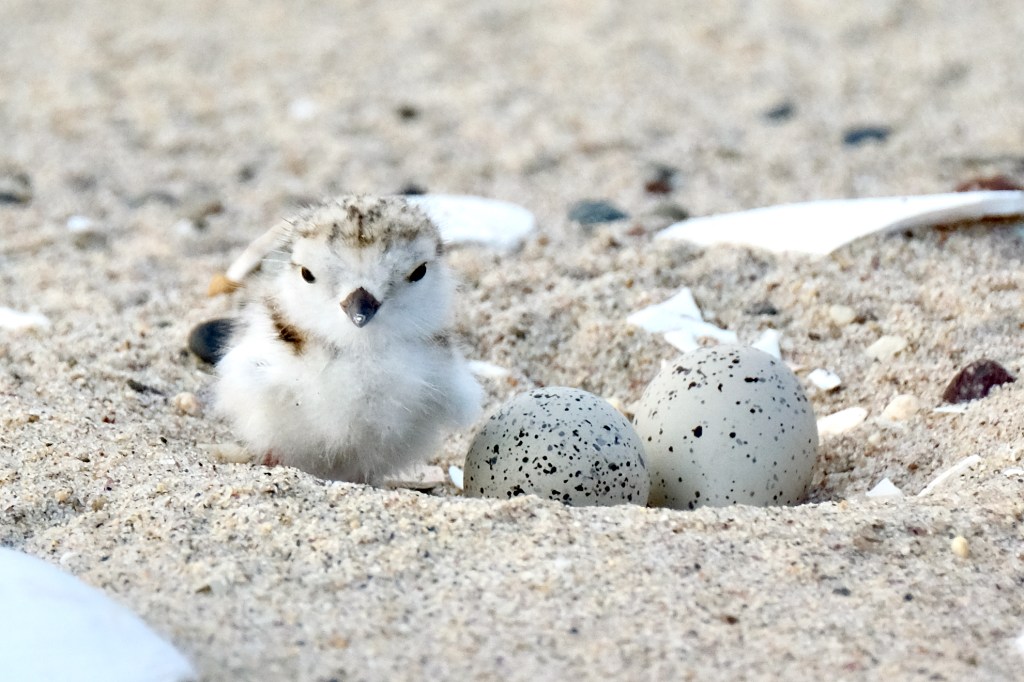
July is nearly through, and so is the piping plover’s nesting season. It’s make-or-break time for these small, endangered shorebirds.
There are roughly 8,000 piping plovers in the entire world. To put that in context, birders often get really excited to see a rare bird like a snowy owl. But there are about 28,000 snowy owls in the world, three times the number of piping plovers.
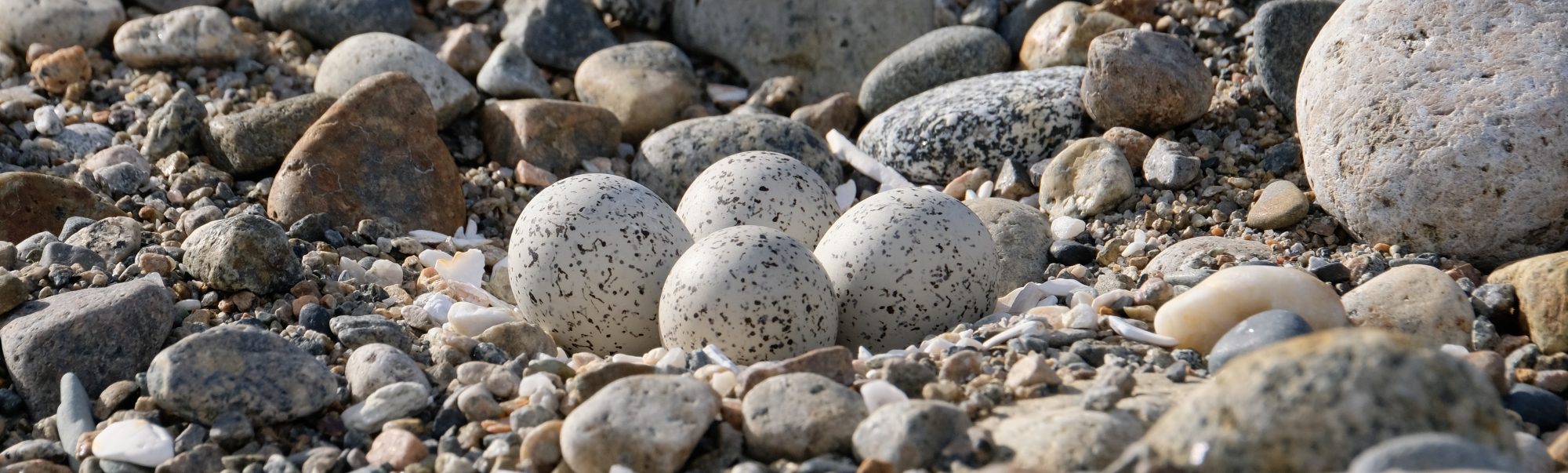
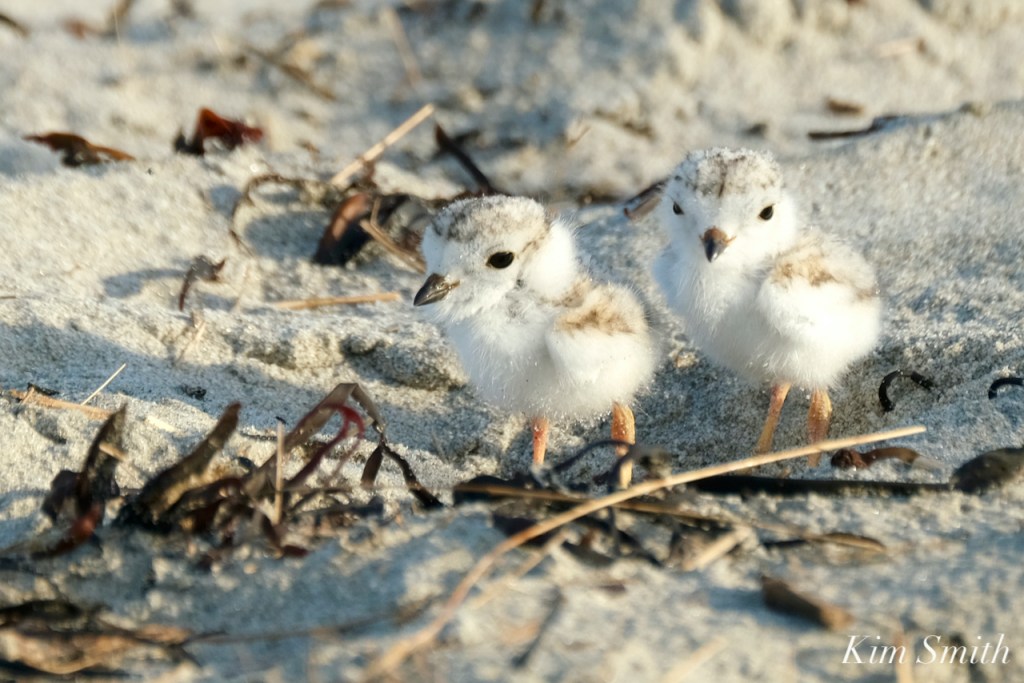
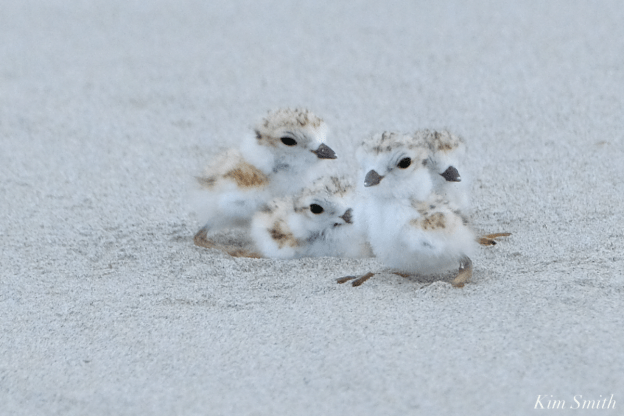
Since piping plovers make their nests along the water and out in the open, their chicks are very vulnerable to being gobbled up by predators. And a major reason for their decline in numbers is human development along the beaches, lakes, and rivers where piping plovers lay their eggs.
SciFri radio producer Shoshannah Buxbaum went out to Fort Tilden in Queens, NY to report on a volunteer-run conservation effort along the New York City coastline.
And later in the segment, Michigan radio reporter Lester Graham talks with guest host Sophie Bushwick about the unique challenges and triumphs of the piping plovers who nest along the Great Lakes.
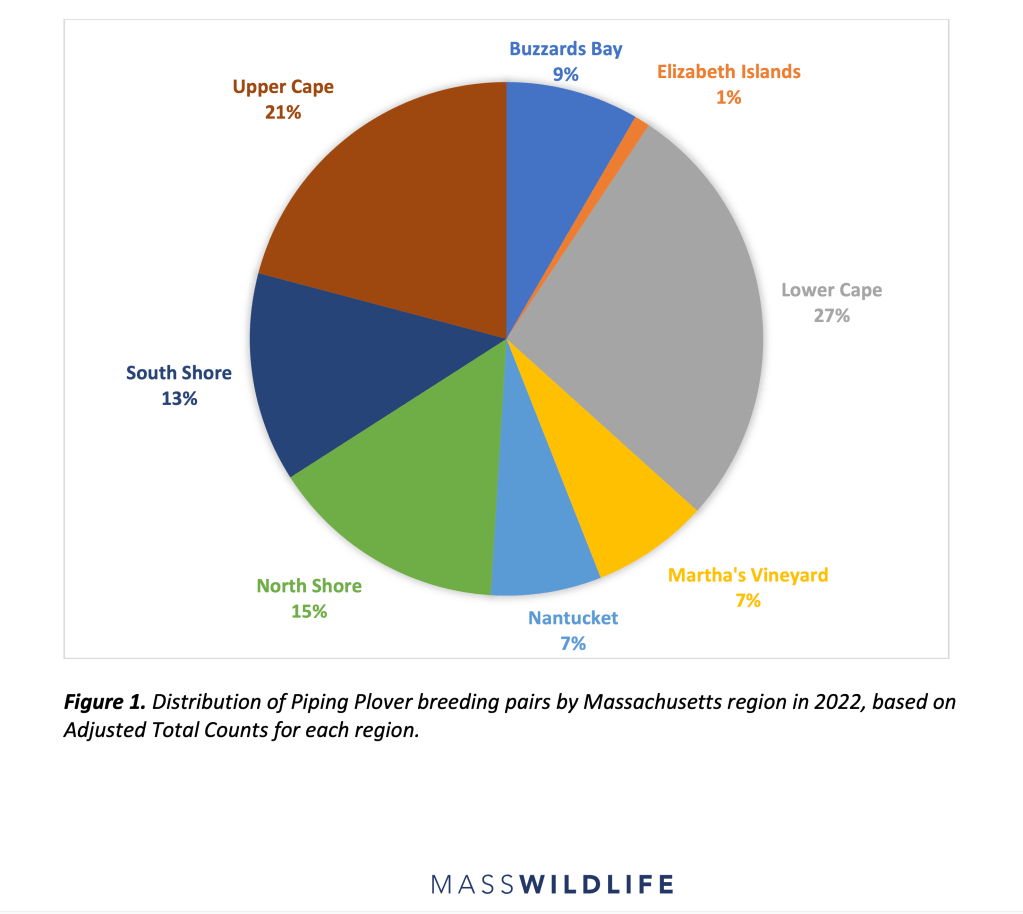
We have received outstanding news from our Massachusetts Coastal Waterbird Biologist, Carolyn Mostello. She shared the” Summary of the 2022 Massachusetts Piping Plover Census.” The grand total for Massachusetts breeding pairs of Plovers is a whopping 1033, up 6.8 percent relative to 2021. A total of 1,330 chicks was reported fledged for an overall productivity of 1.31 fledglings per pair.
The summary is prepared each year by the Natural Heritage and Endangered Species Program, a division of Mass Wildlife. The Summary is in pdf form and I am happy to email anyone the report if you are interested. Please leave a comment in the comment section and your email will pop up on my end. Thank you for your interest!
The following are some highlights from the Summary –
ABSTRACT
This report summarizes data on abundance, distribution, and reproductive success of Piping Plovers (Charadrius melodus) in Massachusetts during the 2022 breeding season. Observers reported breeding pairs of Piping Plovers present at 209 sites; 150 additional sites were surveyed at least once, but no breeding pairs were detected at them. The population increased 6.8% relative to 2021. The Index Count (statewide census conducted 1-9 June) was 1,013 pairs, and the Adjusted Total Count (estimated total number of breeding pairs statewide for the entire 2022 breeding season) was 1,033 pairs. A total of 1,330 chicks was reported fledged in 2022, for an overall productivity of 1.31 fledglings per pair, based on data from 98.6% of pairs.
INTRODUCTION
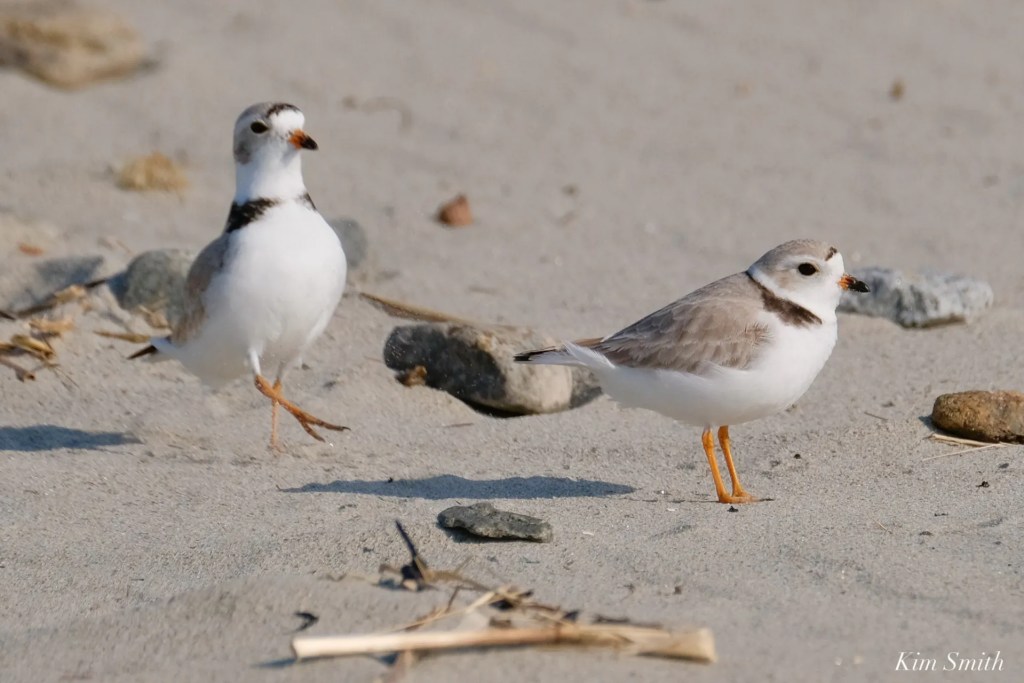
Piping Plovers are small, sand-colored shorebirds that nest on sandy beaches and dunes along the Atlantic Coast from North Carolina to Newfoundland. The U.S. Atlantic Coast population of Piping Plovers has been federally listed as Threatened, pursuant to the U.S. Endangered Species Act, since 1986. The species is also listed as Threatened by the Massachusetts Division of Fisheries and Wildlife pursuant to the Massachusetts’ Endangered Species Act.
Population monitoring is an integral part of recovery efforts for Atlantic Coast Piping Plovers (U.S. Fish and Wildlife Service 1996, Hecht and Melvin 2009a, b). It allows wildlife managers to identify limiting factors, assess effects of management actions and regulatory protection, and track progress toward recovery. In this report, we summarize data on abundance, distribution, and reproductive success of Piping Plovers breeding in Massachusetts in 2022, as observed and reported by a coast-wide network of cooperators.
METHODS
Monitoring and management of Piping Plovers and other coastal waterbirds in Massachusetts is carried out by wildlife biologists, seasonal shorebird monitors, beach managers, researchers, and volunteers affiliated with over 20 federal and state agencies, local municipalities, local and regional land trusts, private conservation organizations, and universities. Cooperators monitored 359 sites in Massachusetts in 2022 for the presence of breeding Piping Plovers.
* * *
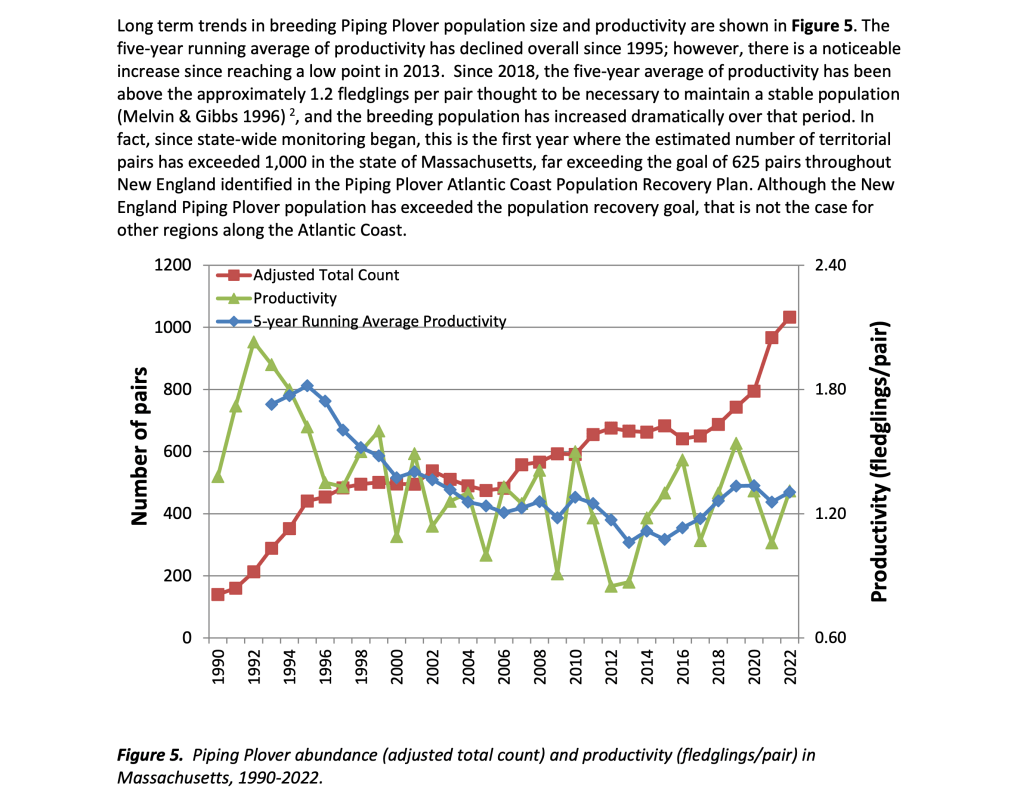
Long term trends in breeding Piping Plover population size and productivity are shown in Figure 5. The five-year running average of productivity has declined overall since 1995; however, there is a noticeable increase since reaching a low point in 2013. Since 2018, the five-year average of productivity has been above the approximately 1.2 fledglings per pair thought to be necessary to maintain a stable population (Melvin & Gibbs 1996) 2, and the breeding population has increased dramatically over that period. In fact, since state-wide monitoring began, this is the first year where the estimated number of territorial pairs has exceeded 1,000 in the state of Massachusetts, far exceeding the goal of 625 pairs throughout New England identified in the Piping Plover Atlantic Coast Population Recovery Plan. Although the New England Piping Plover population has exceeded the population recovery goal, that is not the case for other regions along the Atlantic Coast.
A Gloucester group is seeking volunteers to help look after the piping plovers when they nest at Good Harbor Beach, and setting up a website, pipingploverproject.org, offering information on the birds.
“We have received a number of inquiries regarding the upcoming plover season,” said Gloucester resident and Piping Plover Ambassador Kim Smith of the website. “And we wanted to have a page ready where people could find sign up information.”
“I envision this site as a place where we can not only get information, updates, and stories about our Cape Ann plover families, but to also learn more about plovers in general, other shorebirds, habitat conservation, and how climate change is impacting all,” said Smith in an email.
While this new website, The Piping Plover Project, is under construction, I nonetheless wanted to get it up and running. We’ve received a number of inquiries regarding the upcoming Plover season (just around the corner if you can believe it!) and we wanted to have a page ready where people could find sign up information.
I envision this site as a place where we can not only get information, updates, and stories about our Cape Ann Plover families, but to also learn more about Plovers in general, other shorebirds, habitat conservation, and how climate change is impacting all. If you come across a story or article you would like to see posted here, please forward along. Or if you have a story of your own you would like to share, please, by all means we would love to read it. If you would like to follow this site, move your cursor in the lower right corner and a “follow” box should appear.
Still to come is the FAQs page, which you can help me write if you would like. If an Ambassador is reading this, please let me know what questions you are frequently asked. If a PiPl Friend, please write if you have a question you would like answered. Thank you!
More about becoming a Piping Plover Ambassador
What are the responsibilities of a Plover Ambassador? Plover management is as much about people management as it is about caring for the Plovers. We believe we play an important role in not only representing the Plovers, but it is equally as important to represent Gloucester and Rockport in a positive light. We are there to answer questions, share information, point out the location of the Plovers to interested beachgoers, and direct foot traffic away from the chicks when they are on the beach foraging and resting. Many of our Ambassadors even share their binoculars to better help visitors enjoy watching the chicks.
We begin watching over the chicks on their first day, the day they hatch. The shifts are roughly an hour long, everyday, for about five weeks. We provide coverage from sunrise until sunset. Each person signs up for a specific time ie., 7 to 8, 8 to 9, etc. Several of our Ambassadors like to share their shift with a friend and switching your times around with a fellow Ambassador is okay, too.
If you have any questions or would like to learn more about becoming a Piping Plover Ambassador, please contact Kim Smith at kimsmithdesigns@hotmail.com or leave a comment in the comment section
We are also planning to link this site to a QR code to help folks on the beach who are curious and want to learn more about Cape Ann Plovers.
Thank you for reading. I look forward to being in touch during this upcoming season of the Piping Plover Chronicles.
 The Piping Plover Project