Agenda: 1. Our mission and how we can work together to resolve the problem with the city 2. Governing and decision making structure 3. Committee involvement…ribbed mussels, citizen science, data, beach walk through, press etc. 4. Public Outreach 5. Health data collection…if you have gotten sick please, please, please fill out the form – it is super important 6. Goals for the next 3-6 months 7. Plans of action: emails, signs, grants/funding, etc 8. What are we missing? Please let us know if you think we need to address something
It is super important that we all work together, get the word out, and empower each other by sharing our ideas and experiences. We need to work with the city to better understand the problem in order to provide solutions.
Cheery news to share from PiPl Ambassador Deb- Friday, March 3rd, a Piping Plover was spotted at beautiful West Dennis Beach, on Cape Cod! It won’t be long 🙂
Thank you so very much to Jonathan and Sally for hosting the PiPl meeting and for organizing and compiling the notes. There’s a great deal to tackle here, but we’ll work away at the list. And many thanks to Councilor Jeff for sending the beach regulations, which are also attached. Additionally, Jayne Knot sent along the data from the contaminated Creek reports – very interesting read. I’ve been in touch with Rory McCarthy, who is heading up the Clean the Creek initiative and hope to speak with her this week to see how we can help. She shares lots of great information on her Instagram page at clean_the_creek.
Happy Monday! Warmest wishes, Kim
PiPls in a windy March snowstorm several years ago
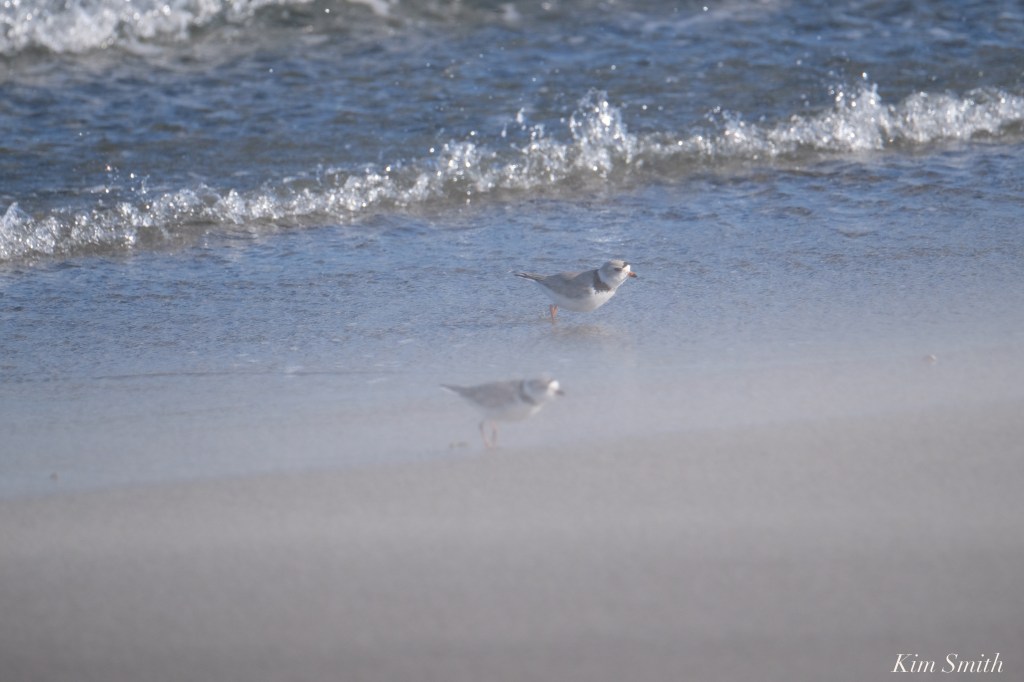
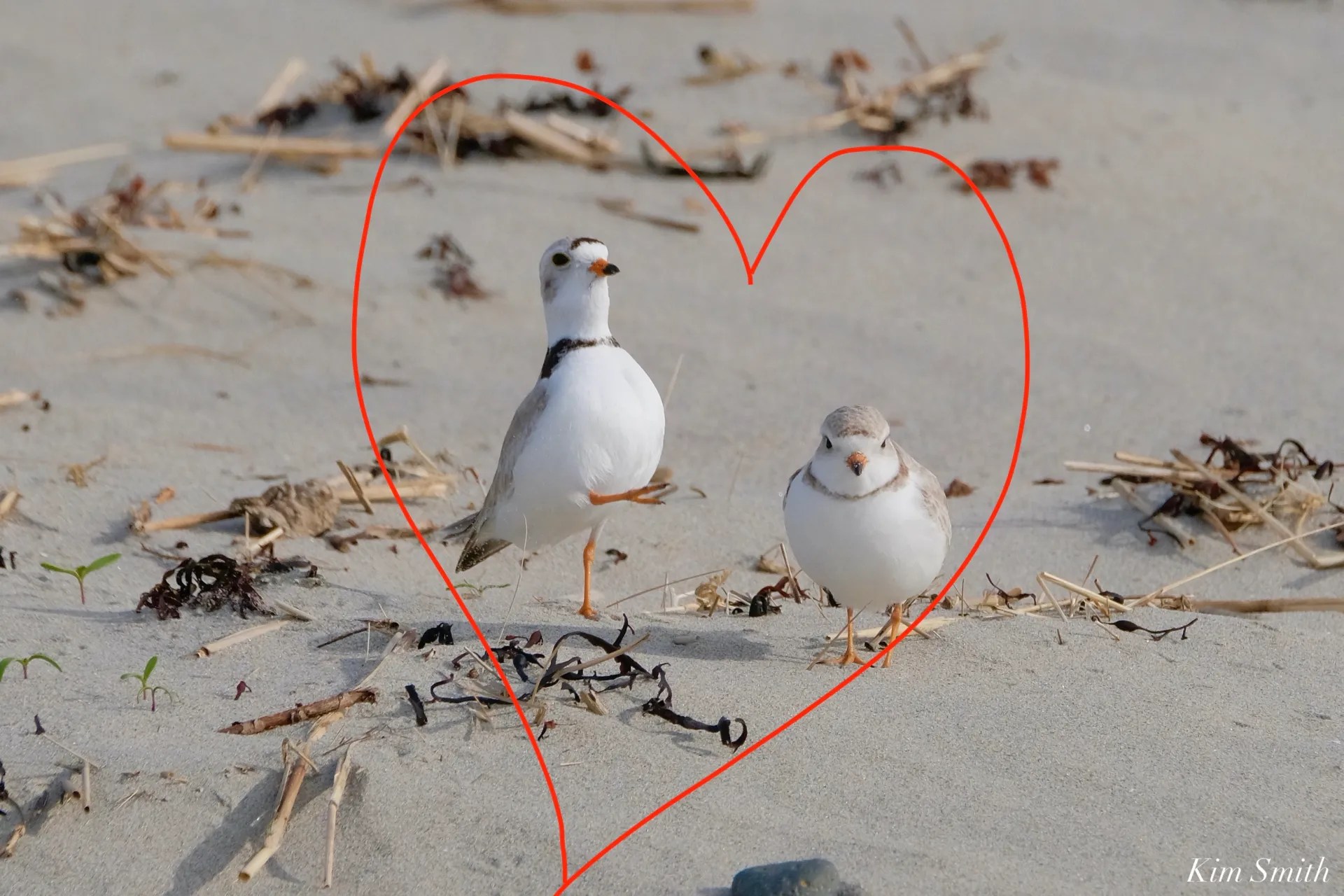
Looking out the window at snow covered scapes, it’s hard to imagine that in just about a month little feathered friends will be arriving at our local beaches. For the past several years, our original Piping Plover pair at #3 has arrived on March 25th. It’s very possible they may have flown directly from their wintering sites, hundreds of miles, if not over a thousand (we know this from banding programs at URI). The pair are usually weary and in need of quiet rest, at least for the first several days… then comes the business of courting and establishing a nest. I am so hopeful our handicapped Mom will be returning for a second summer after losing her foot. It’s unlikely we will see HipHop, not because he wasn’t strong enough to return, but because offspring don’t usually return to their exact birth location. We may see HipHop though at area beaches.
As usual, we will be providing Plover updates in emails, on our new website, Facebook, and Instagram. We are so appreciative of the Gloucester Daily Times’s Andrea Holbrook and Ethan Forman for their recent article highlighting the upcoming Plover season and helping to get the word out about our Ambassador program!
Welcome to our new friends and possible volunteers, George, Meah, Susan, Leslie, and Terry! Thank you so much for offering to volunteer and/or support us in other ways through getting the word out about our Ambassador program.
At our recent Plover organizational meeting, hosted by Jonathan and Sally, we decided our areas of focus are: Safety, Education, Volunteers, and City Support (thank you for organizing the topics Sally!) Jonathan added April/May strategies, which as we seasoned volunteers know, poses a different set of challenges. City Councilor Jeff Worthley was in attendance, and it was a huge help to have someone who can provide insights into what can be accomplished through working with the City. Jeff shared that in the 90s he worked at Good Harbor Beach for five summers and he was also the chairperson of Beach Parking and Traffic Committee that brought us the advance ticket reservation system, so he also has great historical perspective on the ongoing issues at GHB.
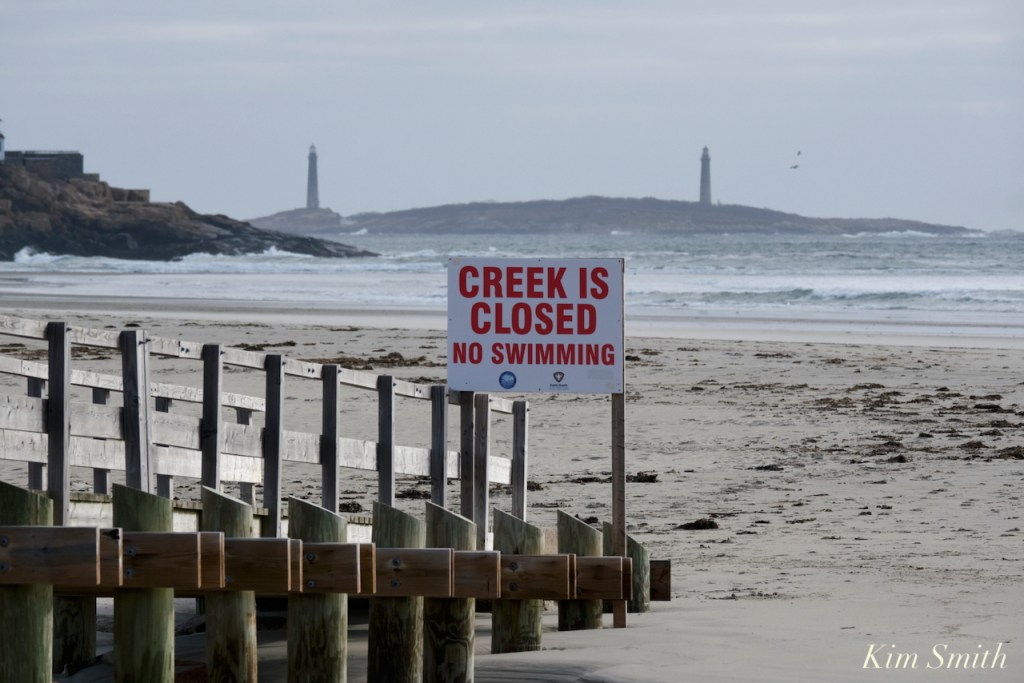
The Creek is still closed due to storm/sewage runoff and it appears the City is no closer to determining the exact source. The fecal matter levels are 14,000 times what is acceptable. This may not seem like a Plover matter (so far, it does not appear to affect their well-being) but it often falls upon the Ambassadors to let people know how unsafe it is to swim there. The high levels are frequently reported on in the GDTimes, but if the City posted the actual levels on the signs at the beach, people might not be so quick to dismiss the warnings. We also discussed that it is probably not safe for swimmers at the mouth of the Creek either as a bunch of surfers that were recently surfing there are reportedly ill. We’d like to thank Councilors Scott Memhard and Jeff Worthley for addressing the contamination at the Creek issue, including walking the beach to let people know, and ensuring the warning signs are in place.
Here is a link to our new website – The Piping Plover Project. Many thanks to PiPl Ambassadors Paula and Alexa for sending along their most frequently asked questions, it was super helpful in putting the post together. Please let me know if you have any FAQs you would like added to the page.
We have received outstanding news from our Massachusetts Coastal Waterbird Biologist, Carolyn Mostello. She shared the” Summary of the 2022 Massachusetts Piping Plover Census.” The grand total for Massachusetts breeding pairs of Plovers is a whopping 1033, up 6.8 percent relative to 2021. A total of 1,330 chicks was reported fledged for an overall productivity of 1.31 fledglings per pair.
The summary is prepared each year by the Natural Heritage and Endangered Species Program, a division of Mass Wildlife. The Summary is in pdf form and I am happy to email anyone the report if you are interested. Please leave a comment in the comment section and your email will pop up on my end. Thank you for your interest!
The following are some highlights from the Summary –
ABSTRACT
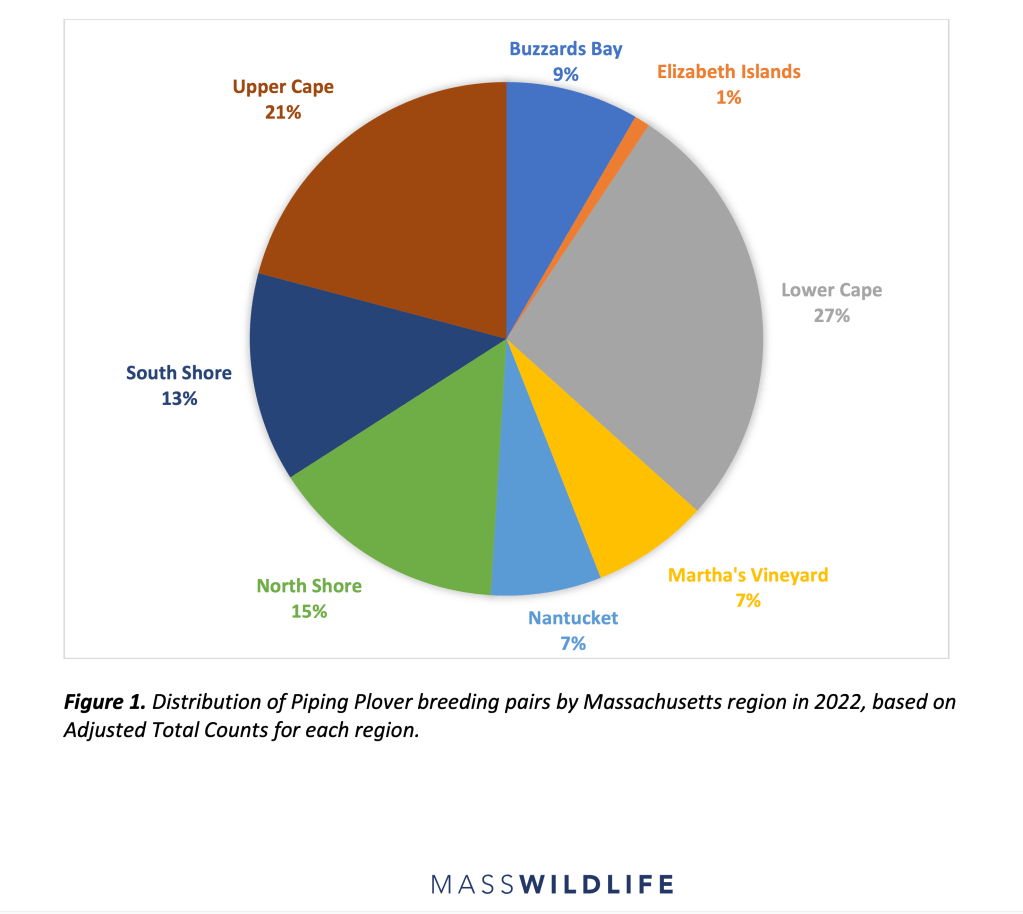
This report summarizes data on abundance, distribution, and reproductive success of Piping Plovers (Charadrius melodus) in Massachusetts during the 2022 breeding season. Observers reported breeding pairs of Piping Plovers present at 209 sites; 150 additional sites were surveyed at least once, but no breeding pairs were detected at them. The population increased 6.8% relative to 2021. The Index Count (statewide census conducted 1-9 June) was 1,013 pairs, and the Adjusted Total Count (estimated total number of breeding pairs statewide for the entire 2022 breeding season) was 1,033 pairs. A total of 1,330 chicks was reported fledged in 2022, for an overall productivity of 1.31 fledglings per pair, based on data from 98.6% of pairs.
INTRODUCTION
Piping Plovers are small, sand-colored shorebirds that nest on sandy beaches and dunes along the Atlantic Coast from North Carolina to Newfoundland. The U.S. Atlantic Coast population of Piping Plovers has been federally listed as Threatened, pursuant to the U.S. Endangered Species Act, since 1986. The species is also listed as Threatened by the Massachusetts Division of Fisheries and Wildlife pursuant to the Massachusetts’ Endangered Species Act.
Population monitoring is an integral part of recovery efforts for Atlantic Coast Piping Plovers (U.S. Fish and Wildlife Service 1996, Hecht and Melvin 2009a, b). It allows wildlife managers to identify limiting factors, assess effects of management actions and regulatory protection, and track progress toward recovery. In this report, we summarize data on abundance, distribution, and reproductive success of Piping Plovers breeding in Massachusetts in 2022, as observed and reported by a coast-wide network of cooperators.
METHODS
Monitoring and management of Piping Plovers and other coastal waterbirds in Massachusetts is carried out by wildlife biologists, seasonal shorebird monitors, beach managers, researchers, and volunteers affiliated with over 20 federal and state agencies, local municipalities, local and regional land trusts, private conservation organizations, and universities. Cooperators monitored 359 sites in Massachusetts in 2022 for the presence of breeding Piping Plovers.
* * *
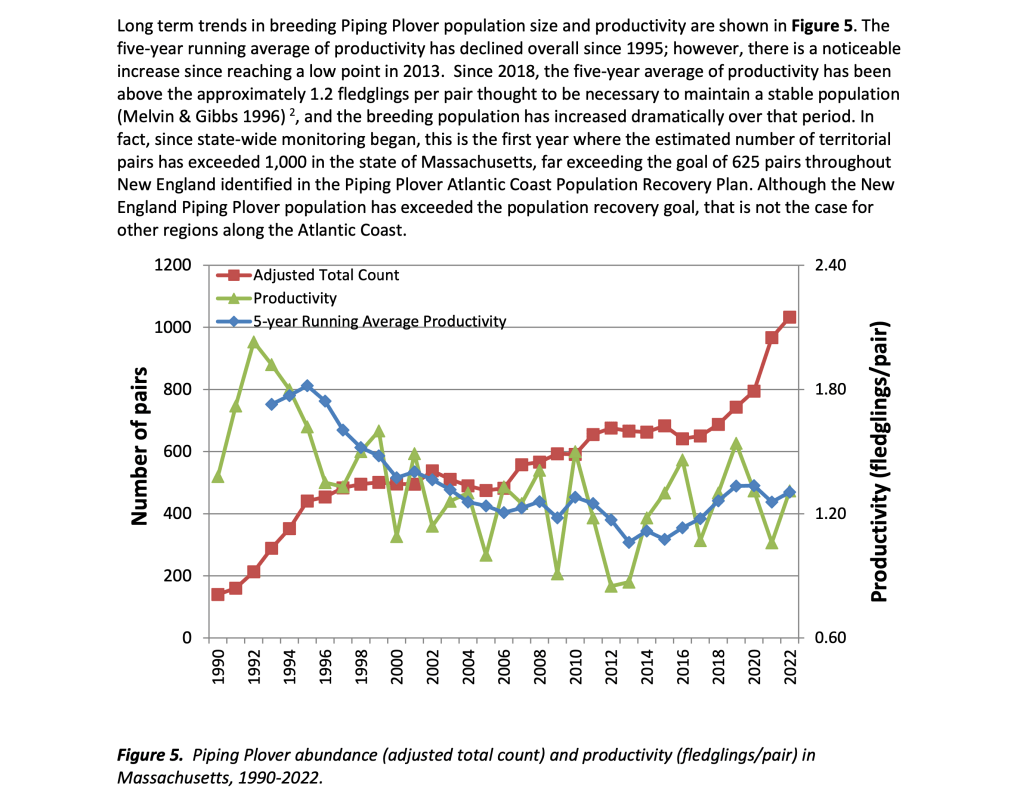
Long term trends in breeding Piping Plover population size and productivity are shown in Figure 5. The five-year running average of productivity has declined overall since 1995; however, there is a noticeable increase since reaching a low point in 2013. Since 2018, the five-year average of productivity has been above the approximately 1.2 fledglings per pair thought to be necessary to maintain a stable population (Melvin & Gibbs 1996) 2, and the breeding population has increased dramatically over that period. In fact, since state-wide monitoring began, this is the first year where the estimated number of territorial pairs has exceeded 1,000 in the state of Massachusetts, far exceeding the goal of 625 pairs throughout New England identified in the Piping Plover Atlantic Coast Population Recovery Plan. Although the New England Piping Plover population has exceeded the population recovery goal, that is not the case for other regions along the Atlantic Coast.
A Gloucester group is seeking volunteers to help look after the piping plovers when they nest at Good Harbor Beach, and setting up a website, pipingploverproject.org, offering information on the birds.
“We have received a number of inquiries regarding the upcoming plover season,” said Gloucester resident and Piping Plover Ambassador Kim Smith of the website. “And we wanted to have a page ready where people could find sign up information.”
“I envision this site as a place where we can not only get information, updates, and stories about our Cape Ann plover families, but to also learn more about plovers in general, other shorebirds, habitat conservation, and how climate change is impacting all,” said Smith in an email.
While this new website, The Piping Plover Project, is under construction, I nonetheless wanted to get it up and running. We’ve received a number of inquiries regarding the upcoming Plover season (just around the corner if you can believe it!) and we wanted to have a page ready where people could find sign up information.
I envision this site as a place where we can not only get information, updates, and stories about our Cape Ann Plover families, but to also learn more about Plovers in general, other shorebirds, habitat conservation, and how climate change is impacting all. If you come across a story or article you would like to see posted here, please forward along. Or if you have a story of your own you would like to share, please, by all means we would love to read it. If you would like to follow this site, move your cursor in the lower right corner and a “follow” box should appear.
Still to come is the FAQs page, which you can help me write if you would like. If an Ambassador is reading this, please let me know what questions you are frequently asked. If a PiPl Friend, please write if you have a question you would like answered. Thank you!
More about becoming a Piping Plover Ambassador
What are the responsibilities of a Plover Ambassador? Plover management is as much about people management as it is about caring for the Plovers. We believe we play an important role in not only representing the Plovers, but it is equally as important to represent Gloucester and Rockport in a positive light. We are there to answer questions, share information, point out the location of the Plovers to interested beachgoers, and direct foot traffic away from the chicks when they are on the beach foraging and resting. Many of our Ambassadors even share their binoculars to better help visitors enjoy watching the chicks.
We begin watching over the chicks on their first day, the day they hatch. The shifts are roughly an hour long, everyday, for about five weeks. We provide coverage from sunrise until sunset. Each person signs up for a specific time ie., 7 to 8, 8 to 9, etc. Several of our Ambassadors like to share their shift with a friend and switching your times around with a fellow Ambassador is okay, too.
If you have any questions or would like to learn more about becoming a Piping Plover Ambassador, please contact Kim Smith at kimsmithdesigns@hotmail.com or leave a comment in the comment section
We are also planning to link this site to a QR code to help folks on the beach who are curious and want to learn more about Cape Ann Plovers.
Thank you for reading. I look forward to being in touch during this upcoming season of the Piping Plover Chronicles.
 The Piping Plover Project